
How to Choose Corporate Uniforms for Real Estate Teams in the UAE
Choosing a suitable corporate uniform for a real estate company involves more than selecting matching shirts and adding a company logo. Real estate professionals move between offices, property viewings, sales meetings, residential communities and client appointments. Their clothing needs to reflect the company’s brand while allowing them to perform different responsibilities comfortably.
A property consultant meeting a potential buyer may require a more formal appearance than a property supervisor conducting building inspections. Similarly, reception employees, leasing coordinators and maintenance teams have different clothing requirements even though they represent the same organisation.
For real estate businesses across the UAE, a well-planned uniform programme should consider job roles, fabric selection, branding, fit, weather conditions and long-term maintenance. This guide explains how to develop a coordinated uniform system for real estate agents, property managers, administrative employees and support teams.
Why Do Real Estate Companies Need Role-Based Corporate Uniforms?
Real estate businesses depend on professional interactions with buyers, sellers, tenants, landlords, investors and property owners. Employees represent the company during office visits, property inspections, client meetings and community activities.
A coordinated uniform programme can help businesses create a consistent visual identity across these interactions.
However, giving every employee exactly the same garment may not be practical.
Consider a real estate company with four departments:
-
Sales consultants who attend property viewings and client meetings.
-
Reception employees who welcome visitors at the office.
-
Property managers who coordinate inspections and maintenance.
-
Administrative staff who manage documentation and customer enquiries.
Each department has different working conditions. A structured uniform programme allows the company to maintain consistent branding while selecting suitable garments for each role.
Key Benefits of a Well-Planned Uniform Programme
Consistent brand presentation: Matching colours, logo placement and garment styles help employees present a recognisable company identity.
Clear staff identification: Branded shirts, name badges and coordinated designs make it easier for clients and visitors to identify employees.
Role-appropriate clothing: Different garment styles can accommodate office work, client meetings, property inspections and operational responsibilities.
Simplified procurement: A documented uniform system makes it easier to manage staff sizes, replacement garments and repeat orders.
Professional team appearance: Coordinated clothing helps maintain a consistent appearance across different branches and departments.
1. Select Uniform Styles According to Real Estate Job Roles
The first step is to identify the different employee categories within the business.
Instead of selecting one garment for everyone, create a uniform plan based on each team’s daily responsibilities.
Real Estate Agents and Property Consultants
Property consultants regularly interact with prospective buyers, sellers, landlords and investors. Their uniforms should support a polished appearance suitable for client meetings and property presentations.
Suitable garment options may include:
-
Formal shirts with tailored trousers.
-
Smart-casual shirts for regular property visits.
-
Blazers for executive meetings and premium sales environments.
-
Branded shirts with subtle embroidery.
-
Coordinated trousers or other suitable lower garments.
For agents who move between an air-conditioned office and outdoor property viewings, lightweight garments can offer more flexibility than heavy formal clothing.
Logo placement should remain professional and discreet. A company logo embroidered on the chest, combined with a name badge where appropriate, can provide clear identification without making the garment look overly promotional.
Sales Gallery and Reception Teams
Reception employees and sales gallery representatives often create the first physical impression of a real estate business.
Their clothing should align with the company’s brand image and the environment in which they welcome clients.
Suitable options include:
-
Formal shirts and trousers.
-
Blouses and coordinated trousers or skirts.
-
Blazers or waistcoats.
-
Smart-casual branded shirts.
-
Coordinated colour combinations with subtle logo branding.
A real estate developer operating a premium property sales gallery may prefer more formal attire, while a smaller brokerage may choose smart-casual uniforms.
The important consideration is consistency between employee appearance and the company’s preferred customer experience.
Property Managers and Community Managers
Property managers may spend part of their working day in an office and the rest visiting residential buildings, coordinating inspections or communicating with tenants.
Their uniforms should allow comfortable movement while maintaining a professional appearance.
Possible options include:
-
Branded polo shirts.
-
Lightweight corporate shirts.
-
Comfortable formal or smart-casual trousers.
-
Lightweight jackets for suitable environments.
-
Company identification badges.
For roles involving regular property visits, garment durability and ease of maintenance become particularly important.
Maintenance Supervisors and Site Coordination Teams
Some real estate businesses have employees responsible for coordinating facilities, building maintenance and property inspections.
These roles may require more practical garments than traditional office uniforms.
Depending on the workplace and actual tasks, suitable options may include:
-
Durable work shirts.
-
Branded polo shirts.
-
Utility or cargo trousers.
-
Lightweight jackets.
-
Appropriate high-visibility clothing where required.
Important: A corporate uniform is not automatically personal protective equipment (PPE). Employees entering construction areas, maintenance zones or other hazardous locations must wear the protective equipment required by the site risk assessment.
Administrative and Back-Office Employees
Administrative employees may spend most of their working hours handling documentation, scheduling viewings, managing records and communicating with customers.
Their uniforms can prioritise everyday comfort, easy maintenance and a consistent corporate appearance.
Branded shirts, polos and coordinated trousers are practical options for many office environments.
2. Choose Fabrics Suitable for the UAE Climate
Fabric selection is an important part of corporate uniform planning, particularly for employees who work across indoor and outdoor environments.
Real estate professionals may spend several hours in air-conditioned offices before travelling to property locations, residential communities or construction developments.
A suitable fabric should account for these different conditions.
Breathable Cotton Fabrics
Cotton is commonly considered for corporate workwear because of its breathability and comfortable feel.
It may be suitable for formal shirts, office uniforms and garments worn for extended periods.
However, fabric weight, weave, fit and care requirements should also be considered. Cotton garments may require more attention to creasing and drying depending on their construction.
Poly-Cotton Blends
Poly-cotton fabrics combine cotton and polyester fibres.
Depending on the fabric construction and fibre ratio, these blends can offer a balance of comfort, durability and easier maintenance.
They may be considered for:
-
Corporate shirts.
-
Reception uniforms.
-
Property management apparel.
-
Branded everyday office wear.
The actual performance depends on the fabric specification rather than the fibre names alone.
Lightweight Performance Fabrics
Some real estate companies may prefer lightweight performance fabrics for staff who travel frequently or spend time outdoors.
When assessing these materials, consider:
-
Air permeability.
-
Moisture management.
-
Fabric weight.
-
Drying requirements.
-
Resistance to repeated washing.
-
Comfort during movement.
Request fabric samples and allow employees to evaluate them under typical working conditions before confirming a bulk order.
Consider Different Requirements for Indoor and Outdoor Roles
The uniform selected for an office-based employee may not be equally suitable for a property supervisor who frequently visits outdoor locations.
For outdoor duties, lightweight, breathable and appropriately fitted clothing deserves particular consideration.
Dubai Municipality’s heat-stress guidance discusses clothing characteristics such as insulation, permeability and ventilation, and recommends suitable lightweight and loose-fitting clothing for relevant hot-work environments. Garment choice should be considered alongside the employer’s broader heat-stress controls and applicable workplace safety requirements.
The practical lesson for real estate companies is to select clothing according to the actual working environment rather than choosing one fabric simply because it looks suitable in a showroom.
3. Create a Consistent Corporate Colour Scheme
Colour is an important part of uniform design because it connects employee clothing with the company’s visual identity.
Real estate businesses should select a limited colour palette that works across departments.
For example:
| Uniform element | Design consideration |
|---|---|
| Main garment colour | Use an approved brand colour or suitable neutral shade |
| Secondary colour | Add contrast through collars, cuffs or garment details |
| Logo colour | Match the approved brand artwork |
| Trousers | Select a coordinated shade suitable for the garment style |
| Name badge | Maintain a consistent format and position |
| Optional jacket | Keep the overall colour combination consistent |
Match Uniform Colours with Brand Guidelines
Before approving a design, review the company’s existing:
-
Logo colour codes.
-
Brand typography.
-
Marketing materials.
-
Office interior colours.
-
Signage and promotional designs.
This helps prevent differences between the colours used in uniforms and other company branding.
Use Different Styles Without Losing Brand Consistency
A real estate company does not need to use exactly the same garment design across every department.
For example, sales representatives may wear formal shirts while community managers wear branded polo shirts.
The garments can still look coordinated through consistent colours, logo size, embroidery style and other design elements.
4. Choose the Right Logo Placement and Branding Method
A company logo is one of the most visible elements of a corporate uniform.
Its placement and branding method should suit the garment type, fabric and intended appearance.
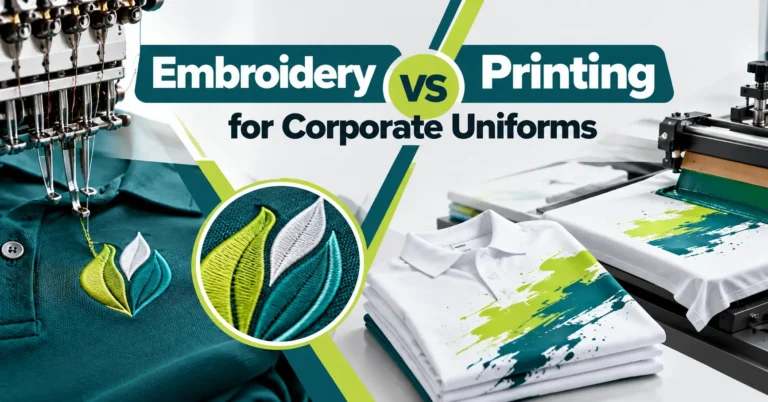
Embroidery for Corporate Shirts and Formal Wear
Embroidery creates a stitched logo on the garment and is commonly considered for corporate shirts, polos, waistcoats and jackets.
It may be suitable when businesses want a textured logo appearance for daily staff apparel.
For effective results, consider:
-
Logo size.
-
Stitch density.
-
Thread colour.
-
Garment fabric.
-
Chest or sleeve placement.
-
Comfort on the inside of the garment.
Avoid making the logo unnecessarily large, particularly on formal clothing.
Real estate agents meeting clients may benefit from a more understated design that keeps the overall appearance professional.
Printing for Selected Corporate Garments
Printing may be suitable for larger logos, polo shirts, promotional clothing and certain lightweight garments.
The appropriate method depends on the artwork, garment fabric, order quantity and expected washing conditions.
Some available options include:
-
Screen printing.
-
DTF printing.
-
Heat-transfer printing.
For smaller company logos on formal shirts, embroidery may be more suitable. For larger graphic designs or selected casual garments, printing may offer greater flexibility.
Rafal offers printing and embroidery options for customised uniforms and corporate apparel.
5. Focus on Fit, Comfort and Professional Appearance
A uniform may have an attractive design, but poor sizing can affect how employees look and feel throughout the working day.
Real estate employees may sit during client meetings, travel between properties, walk through buildings and stand for extended periods.
Their garments should accommodate these activities without feeling restrictive.
Consider Different Body Shapes and Size Requirements
Uniform procurement should account for the actual size requirements of the workforce.
Consider:
-
A suitable size range.
-
Different garment cuts and fits.
-
Sleeve and trouser lengths.
-
Shoulder and chest measurements.
-
Waist and hip measurements.
-
Comfortable movement while sitting and walking.
Companies should offer appropriate garment options for different employees rather than expecting everyone to wear the same cut.
Test Uniforms During Real Working Activities
Before approving the final design, ask selected employees to try the garments during typical work activities.
For example:
-
Sit through a client meeting.
-
Walk around a property.
-
Travel in a vehicle.
-
Attend a property inspection.
-
Work at a reception desk.
Check whether the garment remains comfortable and maintains a suitable appearance during these activities.
Sample approval should include both visual inspection and practical wear testing.
6. Consider Practical Features for Daily Real Estate Work
Small design details can make a noticeable difference to how useful a uniform is.
The requirements will vary depending on the role.
Pockets and Storage
Property consultants and community managers may carry identification cards, pens, small notebooks and mobile devices.
Suitable pockets can improve convenience without making the garment look bulky.
Easy-Care Construction
Since uniforms may be worn repeatedly throughout the week, consider fabrics and construction that are manageable to wash, dry and maintain.
Check:
-
Colour retention.
-
Stitching strength.
-
Shrinkage after washing.
-
Button and zip durability.
-
Resistance to excessive creasing.
-
Logo condition after repeated laundering.
Ask the manufacturer about recommended washing instructions and test samples before bulk approval.
Suitable Layers for Air-Conditioned Offices
Real estate employees may spend significant time in heavily air-conditioned spaces.
A coordinated lightweight jacket, blazer or additional uniform layer may be useful for certain departments.
Optional layers should maintain the company’s colour scheme and branding so that employees still look coordinated when garments are worn separately.
7. Plan Uniform Quantities for Multiple Teams and Branches
Real estate companies may have several branches, sales departments and property management teams across the UAE.
A uniform plan should account for the number of employees, garment requirements and future staffing changes.
Before placing an order, prepare a uniform requirement sheet.
| Department | Garment requirement | Key consideration |
|---|---|---|
| Real estate agents | Formal shirts, trousers, optional blazers | Client meetings and property viewings |
| Sales gallery | Formal shirts, blouses, waistcoats | Coordinated presentation |
| Reception | Corporate shirts or smart-casual attire | Front-desk appearance |
| Property management | Polos, shirts and trousers | Movement and regular site visits |
| Maintenance coordination | Practical shirts and trousers | Durability and task requirements |
| Administration | Shirts or polos and trousers | Daily office comfort |
Maintain a Staff Size Register
Keep a record of each employee’s approved sizes and assigned garments.
This makes it easier to manage new staff requirements, replacement clothing and department-level orders.
Keep Approved Samples for Repeat Orders
Repeat orders can become inconsistent when garment specifications are not documented.
Maintain records of:
-
Approved garment samples.
-
Fabric type and specification.
-
Colour references.
-
Size charts.
-
Logo artwork.
-
Embroidery thread colours.
-
Printing method.
-
Logo dimensions and placement.
This is particularly useful when businesses expand to additional branches or recruit new employees.
8. What Should Real Estate Companies Check Before Ordering Corporate Uniforms?
Selecting a manufacturer is an important part of the uniform procurement process.
The company should review the supplier’s ability to understand the design requirements, produce samples and maintain consistency across the full order.
Here is a practical checklist.
Fabric selection: Does the supplier offer fabric options suitable for office work, property visits and the UAE climate?
Customisation: Can the company select garment colours, styles, logo placement and branding methods?
Sizing: Does the supplier provide a suitable size range and custom sizing where required?
Sample approval: Can the business review physical samples before confirming full production?
Bulk production: Can the supplier manage the required quantities while maintaining garment specifications?
Repeat orders: Can approved fabric, colours, logo placement and sizing details be documented for future orders?
Quality inspection: Are stitching, garment measurements, branding and finishing checked before delivery?
These checks can help businesses avoid unnecessary design changes and sizing inconsistencies during production.
9. Custom Corporate Uniform Manufacturing for Real Estate Businesses in the UAE
For businesses planning a coordinated uniform programme, working with a manufacturer that understands corporate apparel, branding and repeat production can simplify the process.
Rafal Garments Company LLC, based in Ajman, provides customised corporate uniforms for businesses across the UAE.
Its corporate uniform manufacturing service includes options for formal business attire, casual office wear, branded corporate clothing and role-specific workwear.
The available garment collection includes shirts, trousers, suits, waistcoats, jackets, polos and other apparel options.
The corporate uniform process listed by Rafal includes:
-
Design consultation: Discussing garment styles, company colours and uniform requirements.
-
Fabric recommendations: Selecting fabrics based on the intended use and working environment.
-
Custom sizing and sample approval: Reviewing fit and design before bulk production.
-
Logo branding: Applying embroidery, printing or a suitable combination.
-
Bulk production: Producing approved garments according to the agreed specifications.
-
Quality checks: Reviewing stitching, fit and finishing before delivery.
For real estate companies, this approach can help create coordinated clothing for sales agents, reception staff, administration teams and property management employees.
Conclusion: Build a Corporate Uniform Programme That Works for Your Real Estate Team
Choosing corporate uniforms for real estate teams in the UAE requires balancing professional appearance, employee comfort, brand consistency and everyday practicality.
Start by identifying the requirements of each department. Select suitable garment styles for agents, reception employees, property managers and administrative staff. Consider breathable fabrics, appropriate sizing, coordinated colours and suitable logo placement. Before ordering in bulk, approve samples and document the specifications needed for future replacements.
A well-planned uniform programme gives real estate businesses a consistent approach to staff apparel while allowing each team to wear garments suited to its responsibilities.
Planning Corporate Uniforms for Your Real Estate Business in the UAE?
Explore Rafal’s custom corporate uniform manufacturing services to discuss garment styles, fabric options, logo branding and bulk uniform requirements for your team.
Frequently Asked Questions
1. What type of corporate uniform is suitable for real estate agents in the UAE?
Formal shirts, tailored trousers, smart-casual shirts and optional blazers are suitable options for many real estate agents. The final choice should reflect the company’s brand image, client expectations and the employee’s daily activities.
2. Which fabric is suitable for real estate staff uniforms in the UAE?
Cotton, poly-cotton blends and selected lightweight performance fabrics can be considered. The best option depends on garment construction, working conditions, comfort, maintenance requirements and how much time employees spend outdoors.
3. Should all employees in a real estate company wear the same uniform?
Not necessarily. A company can maintain consistent colours and branding while selecting different garment styles for sales agents, reception employees, property managers and maintenance teams.
4. Is embroidery suitable for real estate corporate uniforms?
Yes. Embroidery is commonly used for company logos on corporate shirts, polo shirts, jackets and other garments. The design should be sized appropriately for the garment and tested on the selected fabric.
5. How can real estate companies maintain uniform consistency across multiple branches?
Maintain approved samples, fabric specifications, colour references, size charts, logo artwork and branding instructions. These records help ensure that repeat orders follow the original design.
6. Can corporate uniforms be customised with a real estate company’s logo?
Yes. Company logos can be applied using embroidery or suitable printing techniques, depending on the fabric, garment style, design complexity and intended appearance.
7. What should businesses check before placing a bulk uniform order?
Review fabric suitability, garment samples, staff sizing, colour accuracy, logo placement, stitching, washing performance and the supplier’s ability to manage repeat orders.
8. Does Rafal Garments manufacture corporate uniforms in Ajman?
Yes. Rafal Garments Company LLC is based in Ajman and lists corporate uniform manufacturing, custom garment options, embroidery, printing and bulk production among its services.8