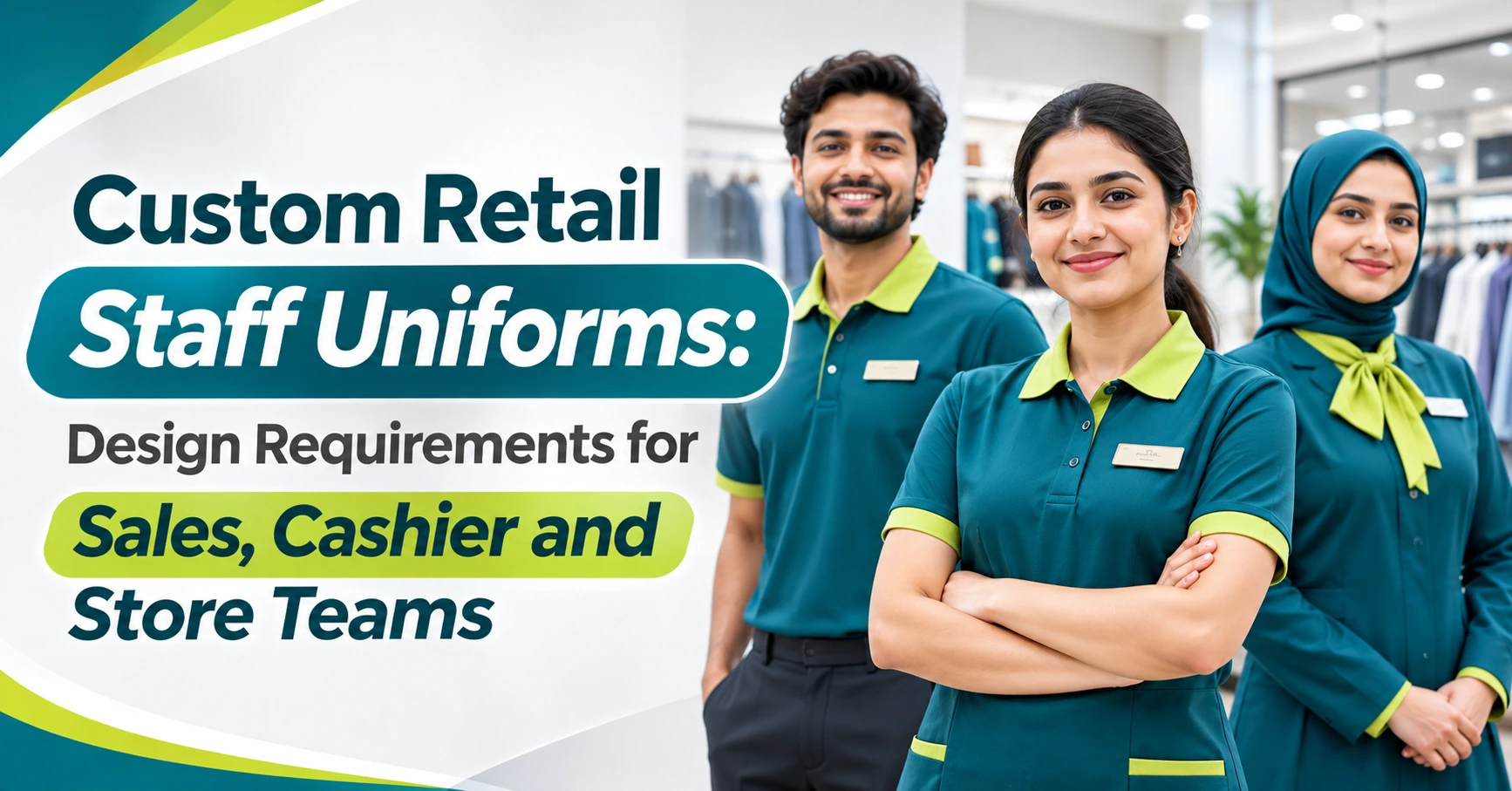
Custom Retail Staff Uniforms in Ajman, UAE: Design Requirements for Sales, Cashier and Store Teams
A well-designed retail uniform does more than give employees a consistent appearance. It helps customers identify staff members, supports brand recognition and provides employees with comfortable clothing for their daily responsibilities. For businesses looking for retail staff uniforms in Ajman, selecting the right design requires considering job roles, fabric, fit, branding and workplace conditions.
Retail environments include supermarkets, fashion boutiques, electronics stores, jewellery shops, department stores and speciality outlets. Each business has different uniform requirements. Sales associates may need smart and presentable clothing, cashiers require practical uniforms for long shifts, and store assistants may benefit from garments that allow comfortable movement during stock handling and product arrangement.
This is why custom retail uniforms should be designed around both brand identity and employee responsibilities. In this guide, we explore the important design requirements for sales, cashier and store teams, including fabric selection, logo placement, sizing, stitching and custom uniform manufacturing considerations for businesses in Ajman and across the UAE.
Why Do Retail Businesses Need Custom Staff Uniforms?
Retail employees interact directly with customers throughout the working day. Their appearance can influence how customers identify staff, understand different roles and recognise a business’s brand.
Custom retail uniforms provide several practical advantages.
Consistent brand presentation: Matching colours, logos and garment styles create a recognisable appearance across the store.
Easy staff identification: Customers can identify sales assistants, cashiers and supervisors more easily.
Employee comfort: Suitable fabrics and garment designs support daily movement and long working hours.
Role-based functionality: Different uniform styles can accommodate the practical requirements of individual departments.
Consistent appearance across branches: Standardised uniform specifications help maintain the same visual identity across multiple retail locations.
For retailers operating multiple outlets in Ajman, Sharjah and other UAE locations, a coordinated uniform programme can also simplify staff onboarding and repeat orders.
Different Retail Staff Roles Require Different Uniform Designs
One of the most important considerations in custom retail uniform manufacturing is understanding that every employee has different responsibilities.
Using exactly the same garment design for every department may not address all workplace requirements. A better approach is to maintain common branding elements while adjusting garment styles according to job roles.
1. Sales Associate Uniforms
Sales associates regularly communicate with customers, explain products and assist with purchasing decisions. Their uniforms should reflect the store’s visual identity while remaining comfortable throughout the shift.
Recommended design requirements:
-
Smart shirts, polo T-shirts or coordinated tops.
-
Well-fitted trousers or appropriate skirts.
-
Consistent brand colours and visible company logos.
-
Comfortable fabric for extended working hours.
-
Optional name badges for easier customer identification.
For fashion boutiques and premium retail outlets, tailored shirts, waistcoats or coordinated formal attire may suit the store’s brand positioning. Sports shops, supermarkets and electronics retailers may prefer branded polo shirts with practical trousers.
The garment style should reflect the type of retail business rather than following a single design for every store.
2. Cashier Uniforms
Cashiers spend considerable time at checkout counters, handling transactions, assisting customers and managing billing activities.
Their uniforms should provide a neat appearance without restricting movement during repetitive tasks.
Important design considerations:
-
Lightweight and comfortable shirts or polo T-shirts.
-
Easy-to-maintain fabric for regular washing.
-
Practical sleeves that do not interfere with checkout activities.
-
Suitable fit for standing and seated work.
-
Clear logo placement on the chest or sleeve.
For supermarkets and large retail chains, consistent cashier uniforms also help customers distinguish checkout employees from other store personnel.
3. Store Assistant and Floor Staff Uniforms
Store assistants and floor employees perform a wide range of activities, including product arrangement, shelf replenishment, customer assistance and inventory support.
Their uniforms should balance a professional appearance with everyday functionality.
Recommended features include:
-
Durable shirts or polo T-shirts.
-
Comfortable trousers.
-
Breathable fabric for active work.
-
Functional pockets where required.
-
Strong stitching around frequently used areas.
For employees who regularly handle stock or move between different store sections, garment flexibility and durability should be considered during design development.
4. Store Supervisors and Managers
Supervisors and store managers may need a slightly different uniform style to distinguish their responsibilities.
Some businesses use a different shirt colour, additional branding details or a more formal garment style for management teams.
For example, sales associates may wear branded polo shirts, while supervisors wear collared shirts or coordinated formal attire.
Maintaining common design elements such as logo placement and brand colours ensures that the entire team still looks connected.
How to Choose the Right Fabric for Retail Staff Uniforms in Ajman
Fabric selection directly affects employee comfort, garment appearance and long-term maintenance.
In Ajman and other parts of the UAE, retailers should consider local weather conditions, indoor air conditioning, outdoor duties and the amount of physical activity involved in each role.
Here are some commonly used fabric options for custom retail uniforms.
| Fabric type | Main characteristics | Suitable applications |
|---|---|---|
| Cotton | Soft and breathable | Sales and customer service teams |
| Polyester | Durable and generally easy to maintain | Daily retail workwear |
| Poly-cotton blend | Combines characteristics of cotton and polyester | Cashiers and store assistants |
| Moisture-wicking fabric | Designed to help manage moisture | Active floor and outdoor-facing staff |
The ideal fabric depends on the garment style, work environment, washing requirements and available budget.
For example, poly-cotton blends may be practical for everyday retail uniforms because they balance comfort and maintenance requirements. Employees working near store entrances or in outdoor promotional areas may need different fabric considerations from employees working entirely inside air-conditioned retail spaces.
Businesses should request fabric samples before confirming bulk uniform production.
Important Design Requirements for Custom Retail Uniforms
Creating a retail uniform requires more than choosing a shirt colour and attaching a company logo. Several design elements should be reviewed before approving the final garment.
1. Brand Colours and Visual Identity
Uniform colours should complement the company’s existing brand guidelines.
Businesses can use primary brand colours for shirts, secondary shades for trousers or skirts, and contrasting colours for small design details.
Maintaining consistent colour combinations across departments helps establish a coordinated retail appearance.
2. Company Logo Placement
The company logo is an important part of branded retail clothing.
Common placement options include:
-
Left chest embroidery.
-
Right chest branding.
-
Sleeve embroidery.
-
Printed logos on the back.
-
Name badges or department identification.
The logo size and placement should suit the garment design. Smaller embroidered logos are commonly used on collared shirts and polo T-shirts, while printing may be suitable for larger designs on selected garments.
3. Comfortable Fit and Sizing
A uniform must fit different employees comfortably.
Retail teams often include employees with different body measurements and garment preferences. Manufacturers should consider suitable size ranges, garment measurements and fitting requirements.
Businesses should check:
-
Shoulder width.
-
Chest and waist measurements.
-
Sleeve length.
-
Trouser length.
-
Garment movement and flexibility.
-
Size consistency across the order.
Providing a size chart and checking sample garments before mass production can reduce sizing issues.
4. Functional Details
Small design features can make a difference in everyday retail work.
Depending on the role, businesses may consider practical pockets, suitable sleeve designs, reinforced stitching and comfortable collars.
However, unnecessary design elements should be avoided because they may increase production costs without providing meaningful workplace benefits.
5. Easy Maintenance and Durability
Retail uniforms are usually worn frequently and washed regularly.
Therefore, businesses should consider fabric colour retention, stitching strength, shrinkage and the manufacturer’s recommended washing instructions.
Choosing suitable fabrics and construction methods can help uniforms maintain their appearance through repeated use.
Embroidery vs Printing for Retail Staff Uniform Branding
Selecting the right branding method is another important part of custom retail uniform production.
Embroidery and printing offer different visual results depending on the garment material, logo design and order requirements.
| Feature | Logo Embroidery | Logo Printing |
|---|---|---|
| Appearance | Stitched, textured finish | Printed graphic finish |
| Suitable garments | Polo shirts and collared shirts | T-shirts and selected workwear |
| Logo designs | Best suited to suitable text and simpler artwork | Supports a wider range of graphic designs |
| Durability | Generally durable with suitable care | Depends on the printing method and garment care |
| Application | Thread stitching | Ink or transfer-based application |
When should retailers choose embroidery?
Embroidery may be suitable for polo shirts, formal shirts and uniforms where a stitched company logo is preferred.
When is printing more suitable?
Printing can be considered for larger logos, promotional designs and garments where a printed finish matches the branding requirements.
The final choice should consider fabric compatibility, design complexity, placement and the desired appearance.
How to Plan Bulk Retail Uniform Manufacturing in Ajman
Businesses ordering uniforms for multiple employees should plan the production process carefully. This helps reduce design changes, sizing issues and inconsistencies between garments.
Here is a practical process retailers can follow.
Step 1: Identify employee roles
Prepare a list of employees across sales, cashier, customer service, store assistants and management departments.
Step 2: Finalise uniform designs
Decide on garment types, brand colours, logo placement and department-specific differences.
Step 3: Select fabrics
Compare fabric options based on comfort, durability, maintenance and workplace conditions.
Step 4: Confirm sizes and measurements
Collect employee size requirements and review the manufacturer’s size chart.
Step 5: Approve a physical sample
Check the garment’s fabric, stitching, fit, colour and branding before approving bulk production.
Step 6: Confirm bulk quantities
Finalise quantities for each department, including additional sets for new employees and future replacements.
Step 7: Inspect completed uniforms
Review stitching, logo placement, colour consistency, sizing and finishing before accepting the completed order.
Maintaining an approved sample and detailed garment specifications also makes future uniform reorders easier.
Why Choose a Custom Uniform Manufacturer in Ajman?
Working with a local custom uniform manufacturer can simplify communication, sample approvals, measurement coordination and production planning.
Businesses should look for a manufacturer that understands different garment requirements and provides relevant stitching, branding and customisation options.
Important factors include:
-
Experience with different uniform categories.
-
Suitable fabric and garment options.
-
Custom logo embroidery and printing.
-
Support for different employee sizes.
-
Sample development before bulk production.
-
Consistent stitching and finishing.
-
Clear communication about order quantities and timelines.
For retail businesses, the ability to customise designs for multiple job roles is particularly important.
A suitable manufacturing partner should understand that cashier uniforms, sales staff clothing and store assistant workwear may require different garment specifications, even when all employees represent the same brand.
Custom Retail Uniform Manufacturing by Rafal Garments Company LLC
Rafal Garments Company LLC is a tailoring and embroidery factory based in Ajman, UAE, providing customised uniform stitching, embroidery and printing services for businesses.
Its uniform services cover different business sectors, including retail, corporate, hospitality, healthcare, construction and logistics. Businesses can discuss garment designs, fabric preferences, sizing and branding requirements according to their team needs.
For retail businesses, customisation can include:
-
Branded shirts and polo T-shirts.
-
Custom garment colours.
-
Company logo embroidery.
-
Printed branding.
-
Role-based garment designs.
-
Uniform sizing and measurement requirements.
-
Bulk uniform stitching.
Rafal also outlines a production process involving fabric selection, design mockups, physical sample approval, stitching, embroidery, printing and final inspection.
Businesses planning new retail uniforms or updating an existing staff dress code can explore custom uniform manufacturing services in Ajman to review available options.
Common Mistakes to Avoid When Designing Retail Staff Uniforms
Even a visually attractive uniform may not meet employee requirements if practical details are overlooked.
Avoid these common mistakes:
Using the same design for every role: Sales, cashier and stockroom employees may have different functional requirements.
Selecting fabric based only on appearance: Consider comfort, climate, durability and washing needs.
Ignoring employee measurements: Incorrect sizing can affect movement and overall appearance.
Using unsuitable logo placement: A logo that is too large or poorly positioned may affect the garment’s visual balance.
Skipping sample approval: Bulk production without checking a physical sample can result in unnecessary adjustments.
Ignoring future requirements: Staff turnover, new branches and team expansion may require repeat orders.
A well-planned design and production process helps businesses avoid these issues.
Conclusion
Custom retail staff uniforms play an important role in creating a consistent brand appearance while supporting employees during their daily responsibilities. Sales associates, cashiers, store assistants and supervisors each have different clothing requirements, making role-based uniform design an important consideration.
For businesses searching for retail staff uniforms in Ajman, the right approach is to evaluate garment styles, fabrics, sizing, branding methods and practical workplace requirements before starting production.
Whether you operate a supermarket, fashion boutique, electronics outlet or speciality retail store, working with an experienced custom uniform manufacturer can help turn your design requirements into coordinated staff clothing.
Rafal Garments Company LLC provides custom uniform stitching, embroidery and printing services in Ajman for businesses looking to develop branded uniforms for their teams.
Frequently Asked Questions (FAQs)
1. What type of uniforms are suitable for retail staff?
Retail staff commonly wear polo T-shirts, formal shirts, trousers, coordinated tops and other branded workwear. The appropriate design depends on the store type, employee responsibilities and brand guidelines.
2. Which fabric is suitable for retail staff uniforms in the UAE?
Cotton, polyester, poly-cotton blends and moisture-wicking fabrics are commonly considered. The ideal option depends on comfort, working conditions, maintenance requirements and garment design.
3. Can cashier and sales staff have different uniform designs?
Yes. Businesses can maintain consistent brand colours and logos while using different garment styles for cashiers, sales associates, supervisors and store assistants.
4. Is embroidery or printing better for retail uniforms?
Embroidery is often suitable for smaller company logos on polo shirts and formal garments. Printing may be more appropriate for larger graphics and selected T-shirt designs. The choice depends on fabric and branding requirements.
5. Can retail businesses order custom uniforms in bulk in Ajman?
Yes. Businesses can coordinate bulk uniform requirements by confirming designs, fabrics, employee sizes, logo placement and quantities before production.
6. Why should businesses approve uniform samples before bulk production?
Sample approval allows businesses to check garment fit, fabric, colour, logo positioning, stitching and finishing before committing to the full order.
7. Where can businesses find a custom uniform manufacturer in Ajman?
Businesses can explore Rafal Garments Company LLC for custom uniform stitching, embroidery and printing services in Ajman, UAE.