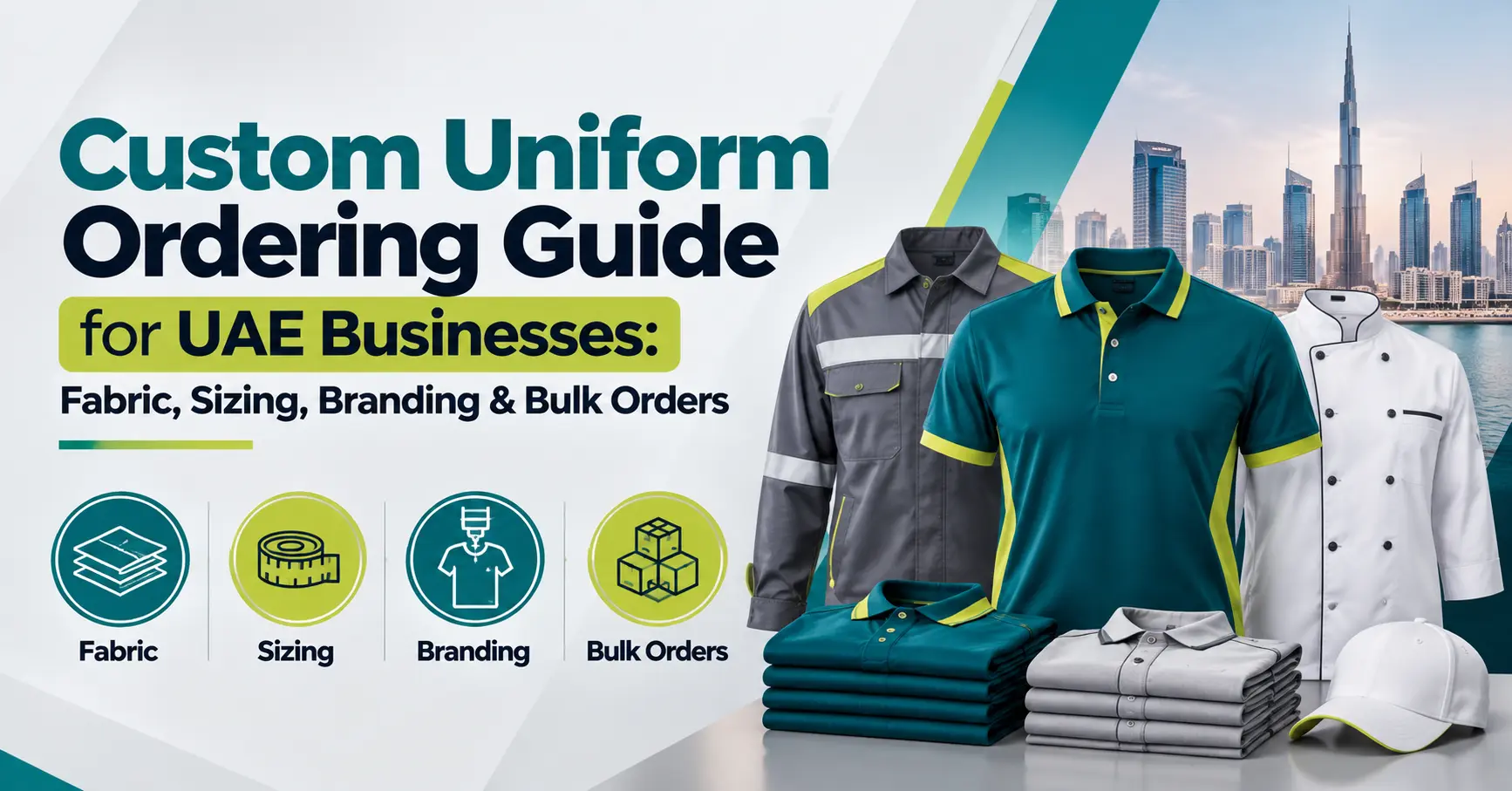
Custom Uniform Ordering Guide for UAE Businesses: Fabric, Sizing, Branding & Bulk Orders
Ordering custom uniforms for a business involves much more than selecting a shirt colour and adding a logo.
The right uniform needs to balance fabric, fit, comfort, workplace requirements, branding, durability, quantity and budget. This is particularly important in the UAE, where businesses may have employees working in offices, retail stores, hotels, restaurants, healthcare environments, schools, warehouses and outdoor locations.
A well-planned uniform programme can create a consistent appearance across teams while making everyday workwear easier to manage.
Whether you need corporate uniforms in Dubai, workwear in Abu Dhabi, staff uniforms in Sharjah, hotel uniforms in Ajman or bulk uniforms across the UAE, this guide explains what to consider before placing an order.
Quick Answer: How Do You Order Custom Uniforms in the UAE?
The most practical process is:
Define the uniform requirement → choose the right fabric → select styles → collect employee measurements → finalise colours → prepare the logo → choose embroidery or printing → determine quantities → approve a sample → confirm production → inspect the order before delivery.
For larger orders, do not skip the sample and size-confirmation stage. A small mistake in fabric, sizing, logo placement or colour can become expensive when multiplied across hundreds of garments.
Why Do UAE Businesses Need Custom Uniforms?
Uniforms can serve several business purposes at the same time.
They can help employees appear visually consistent, make staff easier for customers to identify and support a company’s overall brand presentation.
They are particularly relevant for businesses with customer-facing employees, including:
- Hotels and hospitality businesses
- Restaurants and cafés
- Retail stores
- Schools and educational institutions
- Healthcare facilities
- Security companies
- Construction businesses
- Logistics companies
- Cleaning services
- Salons and beauty businesses
- Automotive workshops
- Corporate offices
- Promotional and event teams
The uniform should therefore be treated as a combination of workwear and brand communication, rather than simply clothing.
Step 1: Define the Purpose of the Uniform
Before choosing fabric or colours, determine where and how the uniform will be used.
Ask:
- Will employees work indoors or outdoors?
- Will they work in air-conditioned environments?
- Will they be exposed to heat?
- Will they move frequently throughout the day?
- Are they working with food?
- Do they need protective workwear?
- Will customers interact with them regularly?
- Does the uniform need frequent washing?
- Is the uniform worn every day?
For example, an office team may need a completely different fabric and fit from a construction or logistics workforce.
A good custom uniform starts with the job requirement, not the logo.
Step 2: Choose the Right Uniform Fabric
Fabric selection is one of the most important decisions when ordering uniforms.
The right fabric should balance:
Comfort + breathability + durability + appearance + maintenance + workplace requirements.
Cotton
Cotton is known for its natural feel and breathability.
It can work well for:
- Office uniforms
- Retail staff
- Hospitality
- Casual corporate wear
However, businesses should consider shrinkage, creasing and drying requirements depending on the fabric construction.
Polyester
Polyester is widely used for workwear because it can offer:
- Durability
- Shape retention
- Easy-care properties
- Resistance to repeated washing
- Consistent colour performance
It can be suitable for uniforms that require regular washing and frequent use.
Cotton-Polyester Blends
Blended fabrics combine characteristics of both fibres.
For many UAE businesses, a cotton-polyester blend can be a practical option where the business wants a balance between comfort, durability and easier maintenance.
The exact performance depends on the fabric composition, weave and garment construction.
Performance Fabrics
Some uniforms use technical or performance-oriented fabrics designed to support:
- Moisture management
- Breathability
- Faster drying
- Lightweight wear
- Active movement
These can be useful for employees working in demanding or warm environments.
Fabric Selection by Business Type
| Business Type | Common Fabric Considerations |
|---|---|
| Corporate Office | Cotton, cotton blend, premium woven fabrics |
| Hotel & Hospitality | Durable cotton blends, easy-care fabrics |
| Restaurant | Easy-maintenance, stain-conscious fabrics |
| Retail | Comfortable cotton blends or polyester blends |
| Construction | Heavy-duty workwear fabrics |
| Logistics | Durable, movement-friendly workwear |
| School | Durable, easy-care fabrics |
| Healthcare | Suitable lightweight, easy-maintenance fabrics |
| Outdoor Teams | Breathable/performance fabrics |
There is no single fabric that works for every business.
How UAE Weather Should Influence Fabric Choice
The UAE climate needs to be considered when uniforms are worn outdoors or during travel between locations.
For outdoor employees, heavy or poorly breathable garments may become uncomfortable during periods of high heat.
For indoor employees, the requirement can be different because offices, hotels and retail environments may be air-conditioned.
Therefore, instead of asking:
“Which fabric is the best?”
ask:
“Which fabric is appropriate for this employee’s working environment?”
That distinction can lead to a much better uniform specification.
Step 3: Choose the Right Uniform Style
Custom uniforms can take many forms.
Common options include:
Polo Shirts
Suitable for:
- Retail teams
- Delivery teams
- Events
- Service businesses
- Casual corporate environments
Formal Shirts
Suitable for:
- Offices
- Hotels
- Front-desk employees
- Sales teams
- Customer-facing roles
Trousers
Choose the cut and fabric according to the employee’s movement requirements and workplace environment.
Blazers
Often used for:
- Corporate teams
- Front-office roles
- Formal hospitality positions
- Executive uniforms
Waistcoats
Commonly used in hospitality and formal customer-service environments.
Tunics and Scrubs
Relevant to selected healthcare and service environments.
Jackets and Workwear
Suitable for:
- Outdoor teams
- Logistics
- Maintenance
- Security
- Construction
- Industrial roles
Step 4: Get Employee Sizing Right
Sizing is one of the most common problems with bulk uniform orders.
Do not estimate sizes simply from employee names or previous clothing purchases.
Different manufacturers can use different size charts.
Instead, request measurements using a single standard measurement guide.
Common measurements include:
- Chest
- Waist
- Shoulder
- Sleeve length
- Shirt length
- Trouser waist
- Hip
- Inseam
- Height, where relevant
Should You Use Standard Sizes or Individual Measurements?
For smaller teams, individual measurements can provide a better fit.
For larger companies, a combination of:
Standard size chart + employee measurement confirmation
can make ordering more manageable.
A practical size sheet might include:
| Employee | Shirt Size | Trouser Size | Fit | Notes |
|---|---|---|---|---|
| Employee 1 | M | 32 | Regular | — |
| Employee 2 | L | 34 | Regular | Long sleeve |
| Employee 3 | S | 28 | Slim | — |
Keep the final size list approved by the responsible company representative before production starts.
Step 5: Select Uniform Colours
Colour is not only a design decision.
It affects:
- Brand recognition
- Professional appearance
- Logo visibility
- Cleaning requirements
- Colour consistency between garments
If the business already has brand guidelines, the uniform should follow the approved corporate colour palette.
For example, if a company uses a particular blue, red or green in its logo, provide the supplier with the actual brand colour reference rather than relying on a verbal description such as “dark blue.”
Step 6: Prepare the Logo for Uniform Branding
Your logo should be supplied in a suitable format.
Preferred formats can include:
- AI
- EPS
- SVG
- High-resolution PNG where appropriate
Vector artwork is especially useful because it can be resized without losing the basic shape and detail.
Before production, confirm:
Logo size + position + colours + thread/print method + placement on each garment.
Embroidery vs Printing: Which Is Better?
The correct branding method depends on the garment and intended use.
Embroidery
Embroidery can work well for:
- Corporate shirts
- Polo shirts
- Jackets
- Hospitality uniforms
- Workwear
It creates a stitched logo directly onto the garment.
Advantages
- Long-lasting appearance
- Professional look
- Suitable for many workwear garments
Considerations
Very small text and highly detailed artwork may need to be simplified for embroidery.
Screen Printing
Screen printing can work well for larger designs and certain fabric types.
It is often considered for:
- T-shirts
- Event uniforms
- Promotional clothing
- Large graphic designs
Heat Transfer Printing
Heat transfer methods can be useful when the design contains:
- Detailed graphics
- Multiple colours
- Names
- Numbers
The correct method depends on fabric type, quantity and durability requirements.
Where Should the Logo Go?
Common logo placements include:
Left Chest
A traditional corporate placement.
Right Chest
Can be used for employee names or secondary branding.
Sleeve
Useful for department names, badges or secondary brand elements.
Back
Provides a larger branding area but should be balanced with the overall design.
Cap
A suitable option for outdoor, retail and service teams.
The key is consistency.
For example:
Left chest = company logo
Right chest = employee name
Sleeve = department or service
A consistent placement system makes large teams look more organised.
Step 7: Plan Bulk Uniform Quantities
Bulk ordering requires accurate quantity planning.
Do not simply calculate:
Number of employees × 1 uniform
Employees may require multiple sets because uniforms need to be washed while another set is being worn.
For example:
50 employees × 3 shirts = 150 shirts
Then consider whether additional pieces are needed for:
- New employees
- Replacement garments
- Different shifts
- Managers
- Different departments
- Different sizes
- Seasonal requirements
Should You Order Extra Uniforms?
For large uniform programmes, keeping a reasonable replacement allowance can simplify future needs.
Extra stock can help when:
- A garment is damaged
- An employee joins the company
- An employee changes size
- A garment becomes unavailable later
- A replacement is needed urgently
However, excessive stock can also create unnecessary inventory costs.
The right quantity depends on employee turnover, replacement frequency and how often uniforms are issued.
Step 8: Create a Uniform Specification Sheet
Before requesting quotations, create one consolidated specification.
Include:
Garment type
Fabric
Fabric composition
Colour
Gender / fit
Size range
Logo
Logo placement
Embroidery or print
Quantity
Packaging requirement
Delivery location
Required delivery date
Additional branding
This prevents suppliers from quoting against different assumptions.
Step 9: Always Approve a Sample Before Bulk Production
A sample is one of the most important stages of custom uniform ordering.
The sample allows you to check:
- Fabric feel
- Colour
- Fit
- Stitching
- Logo size
- Logo position
- Buttons
- Collar
- Pockets
- Labels
- Overall appearance
Do not approve bulk production based only on a digital mock-up.
A design may look perfect on screen but appear different on an actual garment.
Step 10: Check the Production Timeline
Bulk uniform orders require coordination between:
Fabric sourcing → Cutting → Stitching → Branding → Quality inspection → Packaging → Delivery
Ask the supplier for a realistic production schedule.
Do not leave a large uniform order until the last minute, especially when uniforms are required for:
- New business launches
- Hotel openings
- School terms
- Events
- New branches
- Large recruitment drives
How to Compare UAE Uniform Suppliers
Price should not be the only comparison factor.
Compare suppliers based on:
Fabric Specification
Ask for the exact fabric composition rather than just “premium fabric.”
Customisation
Can they produce your preferred style rather than only modify existing garments?
Branding
Do they provide embroidery, printing, labels and other customisation options?
Sampling
Can they produce a pre-production sample?
Bulk Capacity
Can they handle your required quantity within the deadline?
Quality Control
Ask how garments are checked before delivery.
Delivery
Confirm whether delivery is available across the UAE.
Reordering
A supplier should ideally be able to reproduce the same design and specifications later.
Why Reordering Consistency Matters
This is often overlooked.
Imagine a company orders 300 uniforms today and another 100 uniforms six months later.
If the supplier changes:
- Fabric
- Colour
- Pattern
- Stitching
- Logo size
- Button style
the new uniforms may look noticeably different.
For long-term uniform programmes, maintain a master specification containing the approved fabric, colour references, measurements, artwork and garment details.
Custom Uniforms for Different UAE Industries
Corporate Offices
Focus on:
- Professional cuts
- Comfortable fabrics
- Brand colours
- Embroidered logos
- Easy-care garments
Hotels and Hospitality
Uniforms need to balance:
- Appearance
- Comfort
- Frequent washing
- Role-specific design
Different teams may require separate designs for:
- Front office
- Housekeeping
- Restaurant
- Kitchen
- Maintenance
Restaurants
The design should consider:
- Frequent washing
- Food-service environment
- Movement
- Staff identification
- Kitchen requirements
Construction and Industrial Businesses
Workwear should be selected according to the actual workplace risks and applicable safety requirements.
Branding should never replace required protective equipment or safety specifications.
Schools
School uniforms normally require:
- Durable fabrics
- Consistent sizing
- Easy maintenance
- Student-appropriate designs
- Repeat-order availability
Healthcare
Garments should be selected according to the role and facility requirements, with attention to movement, washing and workplace hygiene practices.
How Much Do Custom Uniforms Cost in the UAE?
There is no single fixed price because custom uniform costs depend on several variables.
The main cost factors are:
Fabric
Garment design
Quantity
Number of colours
Embroidery or printing
Number of logo positions
Individual names
Labels
Packaging
Sampling
Delivery
Urgency
For example, 500 basic polo shirts with one embroidered logo will have a completely different cost structure from 500 formal shirts with customised patterns, individual names and multiple embroidery locations.
The best way to compare quotes is to request them against an identical specification.
How to Get an Accurate Uniform Quote
Instead of simply asking:
“How much for 200 uniforms?”
provide:
200 polo shirts + 65/35 cotton-polyester fabric + navy colour + embroidered left-chest logo + individual employee names + S–3XL + approved sample + delivery to Dubai.
A detailed specification enables suppliers to provide a much more meaningful quotation.
Bulk Uniform Ordering Checklist
Before approving a large order, verify:
Product
- Garment type
- Fabric composition
- Colour
- Style
- Size range
Branding
- Logo artwork
- Embroidery or print
- Logo dimensions
- Placement
- Employee names
Quantity
- Number of employees
- Number of garments per employee
- Extra stock
- Department requirements
Production
- Sample approval
- Production deadline
- Quality inspection
- Packaging
Delivery
- Delivery location
- Delivery date
- Split delivery requirements
Commercial
- Unit price
- Branding charges
- Sampling charges
- Delivery charges
- VAT, where applicable
- Payment terms
- Replacement policy
The UAE government states that VAT is levied at 5% on the purchase of goods and services, so businesses should confirm whether quotations are VAT-inclusive or exclusive when comparing supplier prices.
Common Mistakes When Ordering Custom Uniforms
Choosing Fabric Based Only on Price
The cheapest fabric may create higher replacement costs if it does not suit the working environment.
Skipping the Sample
A bulk production problem can become expensive to correct.
Using Unclear Size Information
Different suppliers may interpret S, M, L and XL differently.
Sending Low-Resolution Logos
This can affect embroidery digitisation and print quality.
Ordering the Exact Employee Count
You may have no spare garments for replacements or new hires.
Comparing Different Specifications
A cheaper quote may simply include a lighter fabric, fewer branding positions or lower quantities.
Not Recording the Final Specification
This can create inconsistency during future reorders.
Custom Uniform Ordering Process for UAE Businesses
A simple workflow looks like this:
1. Identify employee roles
↓
2. Define the uniform purpose
↓
3. Select fabric
↓
4. Choose garment styles
↓
5. Finalise colours
↓
6. Prepare logo artwork
↓
7. Confirm size chart
↓
8. Determine quantities
↓
9. Produce sample
↓
10. Approve sample
↓
11. Start bulk production
↓
12. Conduct quality inspection
↓
13. Package and deliver
↓
14. Keep specifications for future reorders
This process reduces avoidable errors and makes future uniform purchases easier.
Frequently Asked Questions About Custom Uniforms in the UAE
What is the best fabric for uniforms in the UAE?
There is no universal best fabric. Cotton, polyester, blended and performance fabrics can all be suitable depending on the employee’s work environment, comfort requirements, washing frequency and uniform design.
How do I choose the right uniform size?
Use the supplier’s specific size chart and collect employee measurements rather than relying only on generic S, M, L or XL labels.
Is embroidery better than printing for uniforms?
It depends on the garment, artwork and usage. Embroidery can work well for corporate logos on polo shirts, shirts and jackets, while printing can be more suitable for larger or more detailed graphics.
How many uniforms should each employee receive?
The appropriate number depends on how frequently uniforms are worn and washed. Businesses should consider work schedules, laundry cycles and replacement requirements rather than using a single fixed number.
Should I order a sample before placing a bulk order?
Yes. A physical sample allows the business to verify fabric, sizing, colour, stitching and branding before committing to large-scale production.
What information should I give a uniform supplier?
Provide the garment type, fabric, colour, sizes, quantities, logo artwork, branding method, placement, delivery location and required deadline.
Can uniforms be customised for different departments?
Yes. A company can maintain one brand identity while using different garment styles or colours for departments such as front office, hospitality, kitchen, housekeeping, sales and operations.
Can I reorder the same uniforms later?
Ideally, yes. Keep the original specification, approved sample and artwork so future production can follow the same requirements.
Are custom uniforms suitable for UAE outdoor workers?
They can be, but fabric, garment construction and any required protective equipment should be selected according to the actual working environment and applicable safety requirements.
Final Takeaway: How to Order Custom Uniforms Successfully
A successful uniform order starts with planning, not pricing.
First understand the employee’s working environment. Then choose a suitable fabric and garment style, establish accurate sizing, prepare the brand artwork and select the appropriate embroidery or printing method.
For bulk orders, the safest process is:
Specification → Sample → Approval → Production → Inspection → Delivery.
Businesses operating across Dubai, Abu Dhabi, Sharjah, Ajman and the wider UAE can also benefit from maintaining a detailed uniform specification for future reorders.
The goal is not simply to produce hundreds of identical garments. It is to create a uniform system that employees can wear comfortably, customers can recognise easily and the business can reorder consistently.