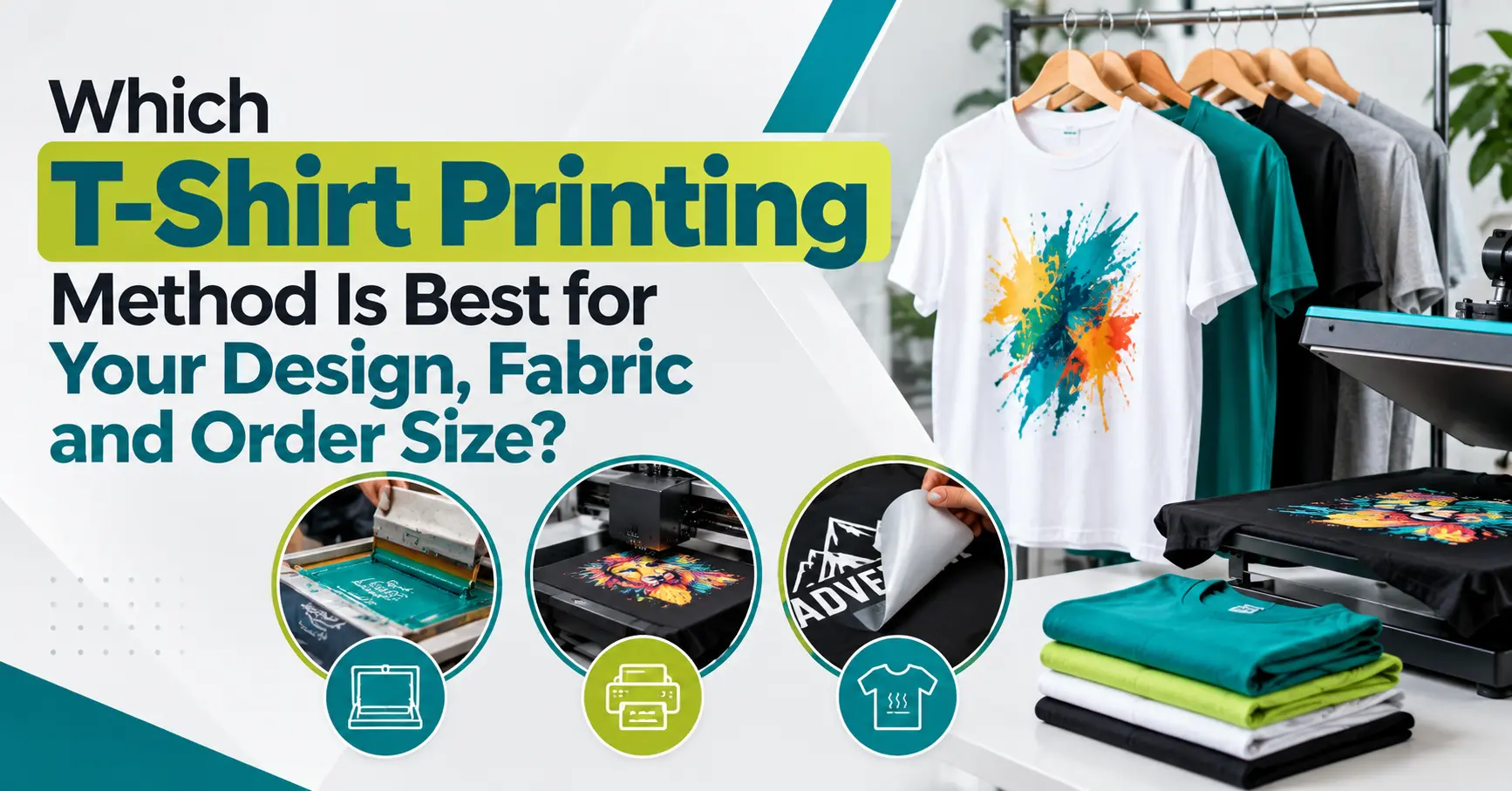
Which T-Shirt Printing Method Is Best for Your Design, Fabric and Order Size?
Choosing the right T-shirt printing method can make a major difference to the final appearance, durability, feel and cost of a custom garment. A technique that works well for a large corporate T-shirt order may not be the best option for a small batch with detailed artwork. Likewise, a printing method suitable for polyester sportswear may not produce the same result on cotton fabric.
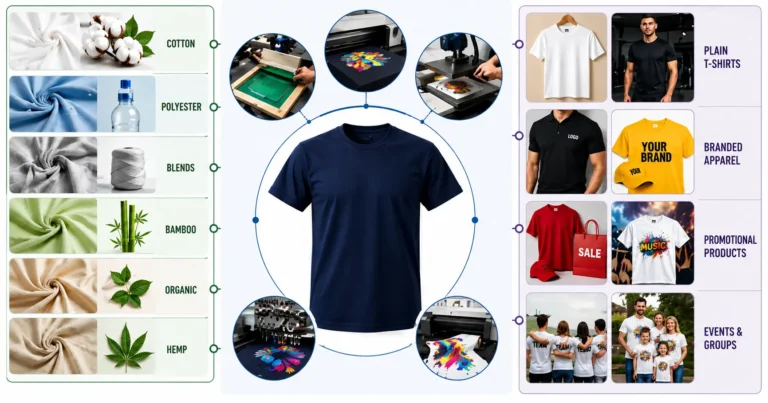
The main options used for custom T-shirts include screen printing, DTF (Direct-to-Film), DTG (Direct-to-Garment), heat transfer and sublimation. Each has different strengths, and the right choice depends on three important factors:
Design + Fabric + Order Size
Rafal Garments Company LLC currently offers screen printing, DTF, digital/DTG, heat transfer and sublimation as part of its garment-printing solutions in Ajman. Its own service information also recommends different techniques according to fabric type, design complexity and order quantity.
This guide explains how to choose the most suitable printing method for your T-shirt project.
What Is the Best T-Shirt Printing Method?
There is no single best method for every T-shirt.
A practical way to choose is:
| Requirement | Method to Consider |
|---|---|
| Large bulk order | Screen printing |
| Detailed multi-colour artwork | DTF or DTG |
| Small or customised batches | DTF, DTG or heat transfer |
| Polyester sportswear | Sublimation |
| Names and numbers | Heat transfer |
| Bold, simple branding | Screen printing |
| Full-colour detailed designs | DTF or DTG |
| All-over polyester designs | Sublimation |
These are general guidelines. The actual choice should be based on the specific garment, artwork, quantity and required finish.
1. Screen Printing: Best for Bulk T-Shirt Orders
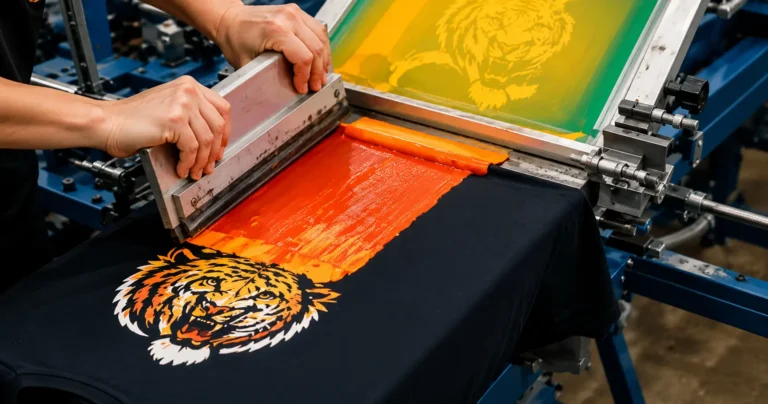
Screen printing is one of the most established T-shirt printing techniques.
It works by transferring ink through a prepared mesh screen onto the fabric.
When Is Screen Printing a Good Choice?
Screen printing is often considered for:
- Large corporate orders
- Event T-shirts
- Promotional apparel
- Staff uniforms
- Simple logos
- Designs with a limited number of colours
Rafal’s current garment-printing service describes screen printing as particularly suitable for large quantities, uniforms and promotional products.
Advantages
- Suitable for bulk production
- Strong colour coverage
- Effective for bold designs
- Can be economical at larger quantities
- Suitable for several fabric applications
Limitations
- Setup is required
- Very detailed photographic artwork may be less practical
- More colours can increase production complexity
Best Example
Imagine a company ordering 500 navy T-shirts with a two-colour company logo.
Screen printing may be a logical option because the design is simple and the quantity is high.
2. DTF Printing: Flexible for Detailed Designs
DTF, or Direct-to-Film printing, involves printing artwork onto a special transfer film and then applying it to the garment using heat and pressure.
DTF has become popular for detailed and multi-colour apparel designs.
When Should You Consider DTF?
DTF can be useful for:
- Detailed logos
- Multi-colour graphics
- Small and medium batches
- Personalised T-shirts
- Corporate apparel
- Promotional garments
- Designs with gradients or complex artwork
Rafal currently lists DTF as an option for detailed logos, gradients and smaller-batch production.
Advantages
- Handles detailed artwork
- Suitable for multi-colour designs
- Flexible for different order sizes
- Can work across a range of garment applications
- Useful for customised apparel
Limitations
The final feel, appearance and durability depend on the particular transfer material, garment and production settings.
Best Example
A company needs 30 T-shirts with a full-colour logo containing gradients and several small design details.
DTF may be more practical than screen printing for this type of order.
3. DTG Printing: Useful for Detailed Direct-to-Garment Designs
DTG, or Direct-to-Garment printing, prints the artwork directly onto the garment using specialised textile printing equipment.
It is particularly associated with detailed, full-colour designs.
When Is DTG Worth Considering?
DTG can be considered for:
- Small production runs
- Detailed artwork
- Full-colour graphics
- Photo-style designs
- Custom apparel
- Cotton-based garments, depending on the specific equipment and process
Rafal’s T-shirt service page lists DTG among its available printing technologies for custom T-shirt production.
Advantages
- Detailed colour reproduction
- No traditional screen setup
- Suitable for small runs
- Useful for complex designs
Limitations
Results depend strongly on the garment, pretreatment, ink system and equipment.
Best Example
A fashion brand wants 20 T-shirts featuring a detailed illustrated artwork with many colours.
DTG can be a suitable option to discuss.
4. Heat Transfer Printing: Useful for Personalised Designs
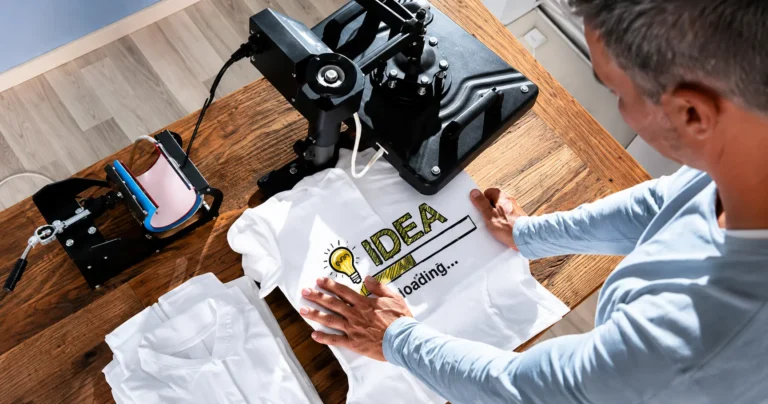
Heat transfer printing applies a printed or cut design to the garment using heat and pressure.
It can be useful when individual garments need different information.
Suitable Applications
- Names
- Numbers
- Small personalised orders
- Event clothing
- Team apparel
- Short production runs
- Specific promotional applications
Rafal currently offers heat transfer printing for customised clothing and lists it among its garment-printing solutions in Ajman.
Advantages
- Flexible for personalised designs
- Useful for small quantities
- Suitable for variable names or numbers
- Practical for certain customised garments
Limitations
Performance depends on the transfer material, garment, application temperature and care conditions.
Best Example
A sports team orders 25 T-shirts with different player names and numbers.
A heat-transfer process can be a practical option for this type of personalisation.
5. Sublimation Printing: Best Suited to Polyester
Sublimation printing uses heat to transfer dye into suitable synthetic fabric.
It is particularly associated with polyester garments and is commonly used for sportswear and all-over designs.
Rafal’s current service page identifies sublimation as a suitable choice for sportswear, synthetic fabrics and full-coverage prints.
When Should You Consider Sublimation?
- Sports jerseys
- Performance T-shirts
- Polyester apparel
- Full-colour designs
- All-over prints
- Teamwear
Advantages
- Suitable for polyester
- Can produce detailed full-colour designs
- Useful for all-over graphics
- Can provide a soft printed feel because the dye becomes part of the fabric
Limitations
Traditional sublimation is generally most suitable for appropriate polyester garments, particularly light-coloured fabrics.
Best Example
A sports academy needs 100 white polyester performance jerseys featuring a full-colour design across the front and sleeves.
Sublimation may be a strong option to discuss.
How Does Fabric Affect the Printing Method?
The same design can produce different results on different fabrics.
Cotton
Cotton is commonly selected for everyday and corporate T-shirts.
Potential options may include:
- Screen printing
- DTF
- DTG
- Heat transfer
The best method depends on the garment and artwork.
Polyester
Polyester is frequently used for sports and performance clothing.
Depending on the specific garment, sublimation can be particularly suitable.
Cotton-Polyester Blends
Blended fabrics require a method that is compatible with the specific fibre composition.
A print provider should confirm the recommended technique before production.
Performance Fabrics
Sports and moisture-managing fabrics may require specialised printing considerations.
Always test or sample where the final result is particularly important.
How Does Design Complexity Affect Your Choice?
The design itself can determine which printing method makes the most sense.
Simple Logo
A simple one- or two-colour logo is often suitable for screen printing, particularly for bulk production.
Multi-Colour Artwork
Complex colour combinations may make DTF or DTG worth considering.
Gradients
Gradients can be more challenging for traditional screen printing and may be better suited to digital processes depending on the garment.
Photographic Artwork
Detailed photographic designs may benefit from digital printing approaches.
Names and Numbers
Heat transfer can be practical when each T-shirt needs different personal information.
Full-Front or All-Over Artwork
The garment size, fabric and desired coverage should determine the most suitable method.
How Does Order Size Affect the Printing Method?
Quantity can have a major influence on production economics.
1–10 T-Shirts
For very small orders, digital or transfer-based methods may be practical.
10–50 T-Shirts
DTF, DTG or heat transfer can be worth considering depending on the artwork.
50–200 T-Shirts
Several methods may work. Compare the design, fabric and required finish.
200+ T-Shirts
For simple, repeatable designs, screen printing can become increasingly attractive for bulk production.
These are general guidelines rather than fixed production rules. Pricing and suitability vary according to the supplier, garment and artwork.
What Is the Best Method for Corporate T-Shirts?
Corporate T-shirt requirements often involve:
- Consistent branding
- Multiple sizes
- Bulk quantities
- Company logos
- Repeat orders
For a simple logo in a large quantity, screen printing can be a practical choice.
For detailed branding or smaller batches, DTF or DTG may be more suitable depending on the garment.
Rafal’s current T-shirt manufacturing page states that it offers screen printing, DTF, DTG, heat transfer and sublimation and selects techniques based on design, fabric and production requirements.
What Is the Best Printing Method for Sports T-Shirts?
Sportswear often uses polyester or performance fabrics.
For suitable polyester garments, sublimation can be a strong option for detailed or all-over designs.
For names, numbers or individual customisation, heat transfer may also be considered.
The fabric should always be checked before the method is finalised.
What Is the Best Method for Promotional T-Shirts?
Promotional T-shirts often involve:
- Larger quantities
- Strong branding
- Short campaigns
- Cost considerations
For simple branding in bulk, screen printing may be appropriate.
For smaller campaigns with detailed multi-colour artwork, DTF or another digital method may be more practical.
What Is the Best Method for Small T-Shirt Orders?
Small orders often favour methods that require less setup.
Depending on the garment and design, consider:
- DTF
- DTG
- Heat transfer
For a handful of highly customised garments, digital or transfer-based options can offer more flexibility than traditional bulk-oriented methods.
Which Printing Method Gives the Softest Feel?
The final feel depends on:
- Printing technology
- Ink or transfer material
- Fabric
- Print coverage
- Production settings
Sublimation can provide a particularly integrated feel on suitable polyester because the dye becomes part of the fabric.
DTG can also provide a relatively integrated finish on appropriate garments.
A sample is the best way to evaluate the actual hand feel of a specific combination.
Which Printing Method Is Most Durable?
There is no universal answer.
Durability depends on:
- Printing method
- Product quality
- Fabric
- Application process
- Washing conditions
- Drying method
- Frequency of use
A properly produced screen print can be durable, while properly applied DTF, DTG, heat transfer or sublimation can also perform well when used on suitable garments.
Do not judge durability based solely on the printing method name.
Screen Printing vs DTF vs DTG vs Heat Transfer vs Sublimation
| Factor | Screen Printing | DTF | DTG | Heat Transfer | Sublimation |
|---|---|---|---|---|---|
| Bulk orders | Excellent | Good | Moderate | Good | Good |
| Small batches | Less suitable | Excellent | Excellent | Excellent | Good |
| Detailed designs | Moderate | Excellent | Excellent | Good | Excellent |
| Simple logos | Excellent | Excellent | Good | Good | Good |
| Names & numbers | Less practical | Good | Less practical | Excellent | Good |
| Cotton | Excellent | Good | Excellent | Good | Limited |
| Polyester | Good | Good | Depends | Good | Excellent |
| All-over prints | Limited | Possible depending on process | Limited | Limited | Excellent |
| Setup requirements | Higher | Lower | Lower | Lower | Process-dependent |
This table is a decision guide, not a substitute for product-specific testing.
How to Choose the Right T-Shirt Printing Method
Use this simple decision process.
Step 1: Look at the Fabric
Ask:
Is the garment cotton, polyester, a blend or another material?
Step 2: Look at the Design
Ask:
Is it a simple logo, detailed artwork, photograph, gradient, name or number?
Step 3: Look at the Quantity
Ask:
Am I ordering 10, 50, 500 or 5,000 pieces?
Step 4: Define the Required Finish
Do you want:
- Strong colour
- Detailed reproduction
- Soft hand feel
- Large coverage
- Personalisation
Step 5: Compare Production Requirements
Consider:
- Setup
- Production time
- Sampling
- Cost
- Reorder requirements
Step 6: Approve a Sample
For larger orders, a sample can help confirm the final result before full production.
Why Sampling Matters Before a Bulk T-Shirt Order
Digital artwork does not always look identical when transferred to physical fabric.
A sample can help you evaluate:
- Fabric colour
- Print colour
- Logo size
- Position
- Sharpness
- Coverage
- Hand feel
- Garment fit
This is particularly useful for corporate orders where hundreds of garments may be produced.
A sample approval stage can reduce misunderstandings between the customer and manufacturer.
What Should You Give Your T-Shirt Printer?
To receive an accurate recommendation and quotation, provide:
- Logo or artwork
- T-shirt colour
- Fabric type
- Quantity
- Size breakdown
- Print location
- Print dimensions
- Required delivery date
- Reference images
- Special requirements
For artwork, vector formats such as AI, EPS or PDF can be useful depending on the supplier’s production workflow.
The more complete the brief, the easier it is to recommend a suitable method.
Common Mistakes When Choosing a T-Shirt Printing Method
Choosing the Method Before Choosing the Fabric
The fabric can influence which printing technology is appropriate.
Choosing Based Only on Price
A low initial cost may not provide the required appearance or durability.
Ignoring Order Quantity
The most suitable option for 10 pieces may not be the most economical choice for 1,000.
Using One Method for Every Design
Different artwork needs different printing approaches.
Skipping Sample Approval
A physical sample can reveal issues that are difficult to identify from a digital mockup.
Not Considering Future Reorders
Businesses with recurring uniform requirements should consider whether the same garment and printing method can be reproduced consistently.
Professional T-Shirt Printing in Ajman
For businesses looking for T-shirt printing in Ajman, the decision should start with the project requirements rather than a single preferred printing method.
Rafal Garments Company LLC currently offers screen printing, DTF, DTG, heat transfer and sublimation as part of its garment-printing and T-shirt manufacturing services in Ajman. The company’s current service information states that its team recommends printing techniques based on factors such as design complexity, fabric type and order quantity.
The company also states that it supports both small and bulk custom T-shirt orders, including corporate, event, team and promotional applications.
For a quotation, businesses should provide:
- T-shirt type
- Fabric preference
- Quantity
- Design
- Size breakdown
- Print position
- Deadline
This gives the manufacturer the information needed to recommend an appropriate production approach.
Frequently Asked Questions
Which T-shirt printing method is best?
There is no single best method. The right choice depends on the design, fabric, order quantity, required finish and intended use.
Which printing method is best for bulk T-shirts?
Screen printing is commonly considered for large orders, especially when the artwork is simple and uses a limited number of colours.
Which T-shirt printing method is best for small orders?
DTF, DTG and heat transfer can be suitable options for small batches depending on the garment and artwork.
Which printing method is best for polyester?
Sublimation is particularly suited to appropriate polyester garments, especially sportswear and full-colour designs.
Which method is best for cotton T-shirts?
Cotton T-shirts can work with several methods, including screen printing, DTF and DTG. The artwork and quantity should determine the final choice.
Is DTF better than screen printing?
Neither is universally better. DTF can offer flexibility for detailed, multi-colour and smaller-batch designs, while screen printing can be attractive for simple bulk orders.
Is DTG suitable for detailed T-shirt designs?
DTG can be suitable for detailed, full-colour designs, particularly in smaller production runs, depending on the garment and equipment.
Is sublimation suitable for black T-shirts?
Traditional dye-sublimation is generally intended for suitable polyester garments and works best on light-coloured fabrics. For dark garments, another printing method may be more appropriate.
Which printing method is best for names and numbers?
Heat transfer is commonly considered for personalised names and numbers because individual garments can be customised without changing the entire production setup.
Should I order a sample before bulk T-shirt printing?
For larger orders, sample approval is advisable because it allows you to check the physical garment, print appearance, colour, placement and overall finish before full production.
Can one T-shirt order use multiple printing methods?
Yes. Different garments or design elements within a project can use different techniques when the production requirements justify it.
Final Thoughts
The best T-shirt printing method depends on three core factors:
Design + Fabric + Order Size
For large orders with simple branding, screen printing can be a practical choice. For detailed artwork and smaller batches, DTF or DTG may offer greater flexibility. Heat transfer can be useful for personalised names and numbers, while sublimation is particularly suited to appropriate polyester sportswear and all-over designs.
There is no need to choose a printing method simply because it is popular. Start with the garment, artwork and quantity, then select the technique that fits the actual production requirement.
For larger projects, approving a physical sample before bulk production can help ensure the final T-shirts meet the expected appearance and specifications.