Screen Printing vs Embroidery for Corporate T-Shirts in Ajman: Which Should You Choose?
When businesses order branded T-shirts, one of the first decisions is how to add the company logo or design. Screen printing and embroidery are two common options, but they create very different results.
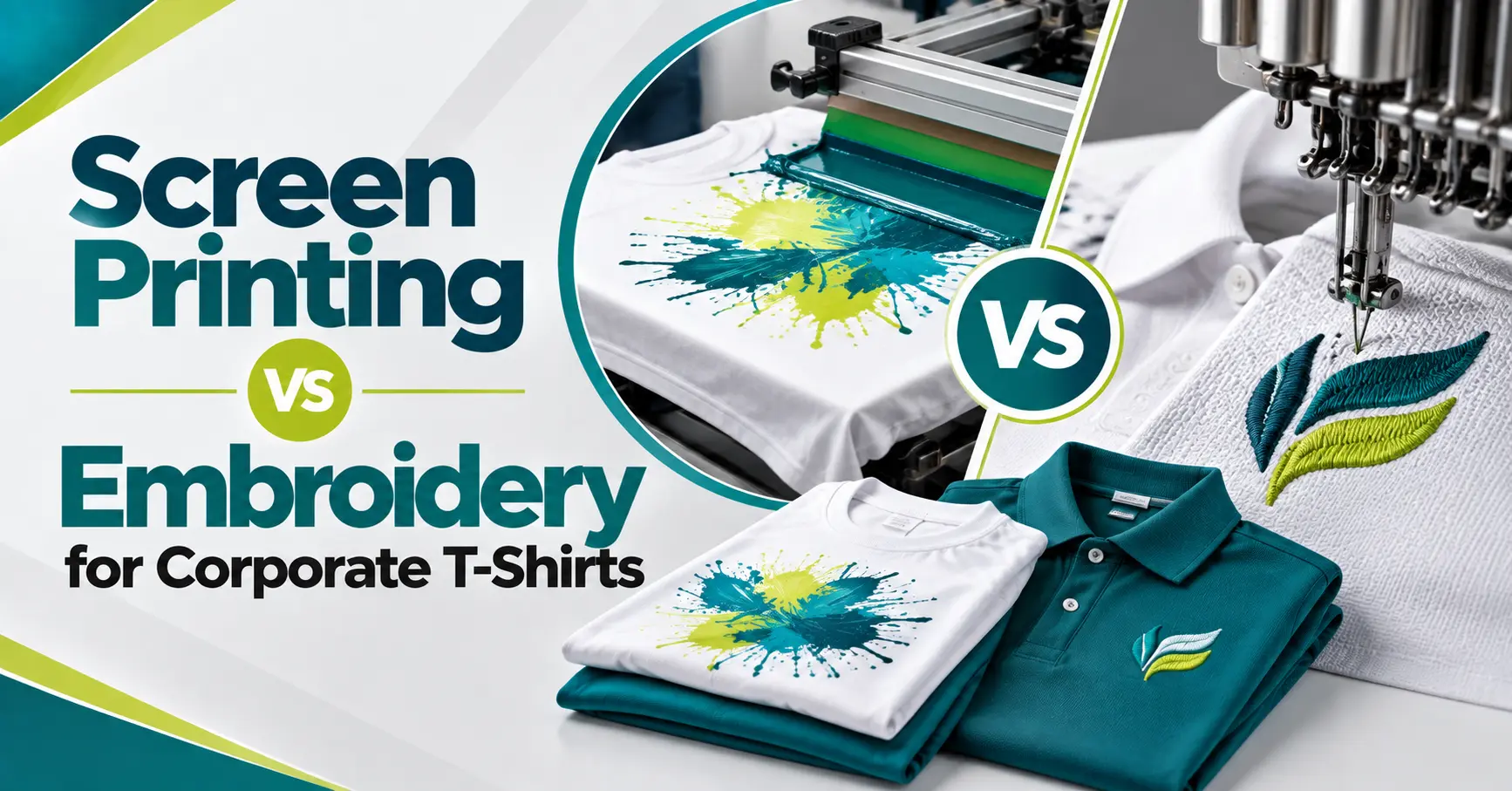
Screen printing applies ink to the garment, making it suitable for printed graphics, larger artwork and many corporate T-shirt applications. Embroidery uses stitched thread and is commonly used for corporate logos on polo shirts, uniforms, shirts, jackets and other apparel. Rafal Garments Company LLC currently provides both printing and embroidery services in Ajman.
The right choice depends on more than appearance. You should consider:
Logo design + garment + fabric + placement + order size + intended use + budget
This guide compares screen printing and embroidery specifically for corporate T-shirts so businesses can choose the method that fits their actual requirements.
Screen Printing vs Embroidery: Quick Comparison
| Factor | Screen Printing | Embroidery |
|---|---|---|
| Application | Ink printed on fabric | Thread stitched into fabric |
| Best suited to | T-shirts and graphic designs | Logos and structured garments |
| Large graphics | Excellent fit | Usually less practical |
| Small chest logos | Suitable | Often a strong option |
| Polo shirts | Suitable | Particularly common |
| Corporate uniforms | Suitable | Suitable |
| Promotional T-shirts | Strong option | Less suitable for large graphics |
| Multi-colour graphics | Suitable | More limited by thread/stitch design |
| Large quantities | Often practical | Also possible |
| Small corporate logo | Suitable | Often a strong choice |
| Photographic artwork | Usually requires another printing approach | Not suitable |
| 3D/stitch appearance | No | Yes |
| Fabric suitability | Depends on print process | Depends strongly on fabric structure |
There is no universal winner. The best method depends on the garment, artwork and purpose.
What Is the Difference Between Screen Printing and Embroidery?
The basic difference is the way the design becomes part of the garment.
Screen Printing
Screen printing transfers ink through a prepared screen onto the fabric.
It is often used for:
- Corporate T-shirts
- Promotional T-shirts
- Event apparel
- Staff T-shirts
- Uniforms
- Large logos
- Graphic designs
Rafal’s current printing service specifically lists screen printing for corporate uniforms, staff apparel, event T-shirts and promotional clothing in Ajman.
Embroidery
Embroidery creates the logo or design with thread stitched into the garment.
It is commonly used for:
- Corporate logos
- Polo shirts
- Uniforms
- Jackets
- Caps
- Workwear
- Corporate apparel
Rafal’s current embroidery service lists corporate offices, uniforms, shirts, jackets and caps among its applications.
The choice therefore depends on whether you want a printed graphic or a stitched corporate identity.
When Should You Choose Screen Printing?
Screen printing can be a strong option when your company wants the branding to be highly visible across a larger printed area.
It is particularly worth considering for:
- Employee T-shirts
- Promotional campaigns
- Trade-show apparel
- Event T-shirts
- Team T-shirts
- Large front designs
- Large back graphics
- Simple company logos
- Consistent bulk orders
For example, a company ordering hundreds of T-shirts with a large two-colour logo could consider screen printing because the design is primarily graphic-based.
Rafal currently identifies screen printing as an option for larger quantities, uniforms and promotional apparel.
When Should You Choose Embroidery?
Embroidery can be especially suitable when the branding is based around a smaller logo and a more structured garment.
Consider embroidery for:
- Polo shirts
- Corporate uniforms
- Work shirts
- Jackets
- Caps
- Staff clothing
- Small chest logos
- Management apparel
For example, a company may want its logo positioned on the left chest of employee polo shirts. Embroidery can provide a clearly defined stitched treatment for this type of application.
Rafal currently provides custom logo embroidery for corporate apparel and uniforms in Ajman.
Which Is Better for a Corporate Logo?
It depends on the logo.
Small and Simple Logo
Embroidery can be a good option, especially on polo shirts, uniforms and structured garments.
Large Logo
Screen printing is usually more practical for a large design because printing can cover a broader area without adding the weight of extensive stitching.
Detailed Graphic
The artwork needs to be assessed before choosing either method.
Small details, very fine text and gradients may require a different production approach.
Logo With Large Text
Screen printing may be suitable when the lettering needs to remain large and highly visible.
For embroidery, the lettering must be large and clear enough to translate well into stitches.
Does the T-Shirt Fabric Matter?
Yes.
The fabric should be considered before choosing the branding method.
Cotton T-Shirts
Cotton T-shirts are commonly used for company apparel and promotional clothing.
Screen printing can be suitable for many cotton T-shirt designs, while embroidery can also work when the fabric has enough structure to support the stitching.
Polo Shirts
Polo shirts are frequently considered for embroidered corporate logos.
The fabric weight and construction should be checked before deciding the embroidery size.
Polyester and Performance Fabrics
Sports and performance garments require more careful consideration because the fabric characteristics can affect the branding method.
Rafal’s current manufacturing information states that printing decisions should take into account factors such as fabric type, design complexity and production requirements.
Which Method Is Better for Large Corporate Orders?
Order quantity is important, but it should not be the only deciding factor.
For large orders, screen printing can be practical when:
- The same design is used on every T-shirt
- The artwork is relatively simple
- The print area is large
- The garments are promotional or event-focused
However, a large order of polo shirts with a small company logo may still be better suited to embroidery.
So don’t use this rule:
Large quantity = screen printing
Instead use:
Large quantity + garment + artwork + placement = method selection
Which Method Is Better for Small Orders?
For small orders, the production setup and artwork matter more.
Embroidery can work well for a small number of:
- Polo shirts
- Corporate shirts
- Staff uniforms
- Jackets
For very small T-shirt orders involving complex graphics, other digital printing methods may also be worth considering.
Rafal currently provides other options, including DTF, DTG, heat transfer and sublimation, alongside screen printing and embroidery.
Screen Printing vs Embroidery for Corporate Branding
The visual style of your brand should also influence the decision.
Screen Printing Creates a Graphic Look
It can work well when the brand wants:
- Strong colour
- Large artwork
- Promotional messaging
- Event graphics
- Highly visible branding
Embroidery Creates a Stitched Look
It can work well when the brand wants:
- A compact logo
- Structured branding
- Corporate uniform styling
- Polo-shirt branding
- Workwear identification
Neither approach is automatically more professional. The garment and brand style determine which one looks more appropriate.
Which Is More Durable: Screen Printing or Embroidery?
This cannot be answered by the technique alone.
Actual durability can depend on:
- Garment quality
- Fabric type
- Thread or ink system
- Production quality
- Design size
- Application
- Washing
- Drying
- Frequency of use
Embroidery can be well suited to garments that receive regular use, while a properly produced screen print can also perform well under repeated wear and washing.
Avoid choosing one solely because someone claims it is “the most durable.” Ask the manufacturer about the specific garment + branding method + intended use.
Rafal’s current embroidery service describes its embroidery as suitable for corporate apparel and regular use, while its printing service discusses durability as part of choosing an appropriate printing technique.
Does Logo Size Affect Embroidery?
Very much.
An embroidery design is converted into stitches, so a logo that looks perfect digitally may need modification before production.
Possible adjustments include:
- Simplifying tiny details
- Increasing small lettering
- Adjusting line thickness
- Reducing unnecessary elements
- Changing stitch density
- Selecting appropriate thread colours
A small chest logo should therefore be prepared differently from a large back graphic.
For printing, the artwork can often accommodate larger graphic areas, although the final result still depends on the chosen printing process and garment.
What About Logo Colour?
Colour can influence the result with both methods.
Screen Printing
The artwork is reproduced through printing inks, with the production setup depending on the number of colours and selected process.
Embroidery
The logo is reproduced using thread colours and stitch patterns.
For a corporate project, provide:
- Original logo
- Brand colour specifications
- Preferred placement
- Approximate size
- Garment colour
A manufacturer can then assess how the logo should be produced.
Rafal’s current services include guidance on design selection, colour and printing technique for branded apparel.
Which Is Better for T-Shirts and Which for Polo Shirts?
A simple practical starting point is:
T-Shirt + Large Logo
Screen printing
T-Shirt + Promotional Graphic
Screen printing
Polo + Small Company Logo
Embroidery
Corporate Shirt + Small Chest Logo
Embroidery
Jacket + Company Logo
Embroidery
Event T-Shirt + Large Artwork
Screen printing
These are general starting points, not fixed rules. The garment should always be assessed before production.
Can You Combine Printing and Embroidery?
Yes.
A company can use both methods within a single corporate apparel project.
For example:
Front chest: Embroidered company logo
Back: Screen-printed campaign graphic
Another example:
Left chest: Embroidered brand logo
Sleeve: Printed department or event information
This can be particularly useful when one part of the garment needs a compact corporate identity while another part needs a larger graphic.
The manufacturer should check whether the selected garment can accommodate both applications properly.
What If Neither Screen Printing Nor Embroidery Is Ideal?
This is an important part of the decision.
A corporate logo may include:
- Photographic elements
- Fine gradients
- Extremely small details
- Many colours
- Complex artwork
In such cases, another printing technique may be more suitable.
Rafal currently offers DTF, DTG, heat transfer and sublimation in addition to screen printing, depending on the garment and project requirements.
So the decision should not be forced into:
Printing OR Embroidery
It can instead be:
Screen Printing vs Embroidery vs Digital Printing
based on what the actual project requires.
How Does Order Size Affect the Decision?
Order quantity influences production economics, but it doesn’t determine the branding method by itself.
Consider three examples.
20 Corporate Polo Shirts
Small logo + polo fabric → embroidery may be appropriate.
300 Event T-Shirts
Large graphic + identical design → screen printing may be appropriate.
50 Detailed Promotional T-Shirts
Complex artwork + smaller quantity → DTF or another digital process may be worth comparing.
This is why a quotation should be based on the complete project specification, not simply the number of garments.
How Does Placement Affect the Choice?
Logo placement can influence both appearance and practicality.
Common placements include:
- Left chest
- Right chest
- Centre front
- Full back
- Sleeve
- Upper back
Left Chest
Often suitable for a small embroidered corporate logo.
Full Front
Often better suited to printing.
Full Back
Screen printing can be practical for larger graphic designs.
Sleeve
Either method may be possible depending on logo size and garment construction.
Always confirm the actual dimensions before production.
Which Method Should You Choose for Staff Uniforms?
Think about how the garment will be used.
For daily staff uniforms, consider:
- Frequency of washing
- Fabric
- Logo size
- Employee role
- Garment style
- Branding visibility
A small embroidered logo can work well for polo-style uniforms, while printed branding can be more practical when the design occupies a larger area.
Rafal’s current uniform service supports both embroidery and printing options, including logo embroidery, screen printing, DTF prints and name tags.
Which Method Should You Choose for Promotional T-Shirts?
Promotional T-shirts often prioritise:
- Visibility
- Brand colours
- Graphic impact
- Quantity
- Campaign timing
Screen printing can be a practical option for consistent designs across larger quantities.
For complex artwork or smaller runs, digital printing alternatives may be more suitable.
The key question is:
Is the T-shirt primarily a corporate uniform or a promotional marketing item?
That distinction can change the recommended branding method.
How Much Does Screen Printing or Embroidery Cost?
There isn’t one fixed price for either method.
The quotation can depend on:
Garment
- T-shirt or polo
- Fabric
- Colour
- Garment quality
Artwork
- Logo size
- Number of colours
- Stitch complexity
- Print area
- Placement
Quantity
- Number of garments
- Size breakdown
- Repeated designs
Production
- Artwork preparation
- Digitisation
- Sampling
- Finishing
- Delivery requirements
Therefore, comparing only the price per T-shirt may not give you a meaningful comparison.
Ask for a quotation based on the same garment and the same logo specification.
What Should You Send to the Manufacturer?
For an accurate quotation, prepare:
- Company logo
- Original artwork
- Brand colours
- T-shirt or polo preference
- Fabric requirement
- Quantity
- Size breakdown
- Logo placement
- Approximate logo size
- Required delivery date
For embroidery, ask whether digitising the logo is included or charged separately.
For printing, ask whether the supplied artwork is production-ready.
A complete brief makes the comparison much easier.
Why Should You Approve a Sample First?
A digital mock-up cannot always show exactly how branding will appear on fabric.
A physical sample lets you evaluate:
- Logo size
- Placement
- Colour
- Print coverage
- Stitch appearance
- Fabric interaction
- Overall balance
This is particularly important for bulk corporate orders.
For example, a logo that appears correctly proportioned on a screen may look too large when embroidered on a polo chest.
Approving one sample first can help catch these issues before full production.
Common Mistakes Businesses Make
Choosing the Cheapest Method
Price alone does not tell you whether the method is suitable.
Choosing the Method Before the Garment
The garment should be part of the decision from the beginning.
Making an Embroidered Logo Too Detailed
Tiny text and fine artwork may need simplification.
Using a Large Embroidery Design on a Lightweight T-Shirt
Too much stitching can affect the garment’s drape and appearance.
Choosing Screen Printing for a Very Small, Detailed Order Without Comparison
Another printing technology may offer a more practical solution.
Skipping Sample Approval
A bulk order magnifies even a small design mistake.
Not Documenting the Branding Specification
For repeat corporate orders, keep the logo size, placement, garment model and branding method recorded.
A Simple Decision Guide
Use these questions before placing an order.
Is the design large?
Yes → Consider screen printing.
Is it a small corporate logo?
Yes → Consider embroidery, particularly for polos or uniforms.
Is it a large bulk T-shirt order?
Yes → Screen printing may be practical.
Is it a polo or structured corporate shirt?
Yes → Embroidery may be a strong option.
Does the artwork contain complex gradients or photographic detail?
Yes → Compare digital printing options as well.
Will the garment be worn as a daily uniform?
Yes → Consider both the branding method and garment construction.
This is a better decision process than asking which method is universally superior.
Screen Printing vs Embroidery: Final Comparison
| Factor | Screen Printing | Embroidery |
|---|---|---|
| Large graphic | ✅ Strong fit | ⚠ Usually less practical |
| Small logo | ✅ Suitable | ✅ Strong fit |
| T-shirts | ✅ Strong fit | ✅ Possible |
| Polo shirts | ✅ Possible | ✅ Strong fit |
| Corporate uniforms | ✅ Suitable | ✅ Strong fit |
| Promotional T-shirts | ✅ Strong fit | ⚠ Less suitable |
| Large quantities | ✅ Often practical | ✅ Suitable |
| Detailed graphic | Depends on design | Requires stitch-friendly artwork |
| Premium stitched appearance | ❌ | ✅ |
| Large print area | ✅ | ⚠ |
| Small chest branding | ✅ | ✅ |
| Names | Possible | Possible |
| Complex photographic artwork | Consider digital printing | ❌ |
| Fabric dependency | High | High |
Corporate T-Shirt Branding in Ajman
For businesses in Ajman, the right choice is best made by sharing the complete garment and branding brief with the manufacturer.
Rafal Garments Company LLC currently provides screen printing and embroidery in Ajman, along with other printing options including DTF, DTG, heat transfer and sublimation. Its current services cover corporate apparel, uniforms, promotional clothing and other branded garments.
Rafal’s current product pages specifically include corporate T-shirts and uniforms with customization through embroidery and printing.
For a quotation, provide:
Garment → Fabric → Logo → Quantity → Placement → Deadline
The manufacturer can then determine which branding method best matches the project.
Frequently Asked Questions
Is screen printing better than embroidery for corporate T-shirts?
Neither is universally better. Screen printing is often a suitable choice for larger printed graphics and corporate T-shirts, while embroidery can be particularly suitable for smaller logos on polo shirts, uniforms and structured apparel.
Which is better for a company logo on a polo shirt?
Embroidery is often a natural option for a small corporate logo on a polo shirt, although the fabric, logo and desired appearance should still be assessed.
Which is better for a large T-shirt logo?
Screen printing is generally more practical for a large graphic area because it can cover broader sections of the garment without extensive stitching.
Is embroidery suitable for T-shirts?
Yes. Embroidery can be used on suitable T-shirts, but fabric weight, construction and logo size should be considered before production.
Is embroidery more durable than screen printing?
Not necessarily in every situation. Actual durability depends on the garment, materials, application quality, washing and frequency of use.
Which is more suitable for bulk corporate T-shirts?
Screen printing can be practical for large quantities of identical T-shirts, especially when the design is consistent. Embroidery can also work for bulk uniforms or polo shirts.
Can the same corporate garment use both methods?
Yes. A small embroidered chest logo can be combined with a larger screen-printed graphic where the garment and design support both applications.
Does embroidery work with detailed logos?
It can, but very fine details and small lettering may need to be simplified or resized to work effectively as stitches.
Should I choose screen printing or embroidery based only on price?
No. Compare the same garment, logo size, placement, quantity and production specification when evaluating quotations.
What information should I give a T-shirt manufacturer?
Provide the garment type, fabric, logo, brand colours, quantity, size breakdown, logo placement, approximate dimensions and required delivery date.
Can DTF be an alternative to embroidery or screen printing?
Yes. DTF can be considered for certain detailed or multi-colour designs, particularly when the project requirements make it a better fit. Rafal currently offers DTF alongside other garment-printing methods.
Final Thoughts
Choosing between screen printing and embroidery for corporate T-shirts in Ajman should start with the project rather than the printing method.
Choose screen printing when:
Large graphic + T-shirt + strong visual branding + consistent order
Consider embroidery when:
Small logo + polo/uniform + structured corporate appearance
And when the artwork is highly detailed or the quantity is small, compare additional options such as DTF or DTG instead of forcing the design into one of these two methods. Rafal currently offers these additional garment-printing options in Ajman.
The most reliable process is:
Select the garment → Assess the logo → Choose placement → Compare techniques → Approve a sample → Proceed with production
For businesses ordering branded apparel in Ajman, this approach makes the final choice based on the actual corporate requirement, not simply on which technique sounds better.