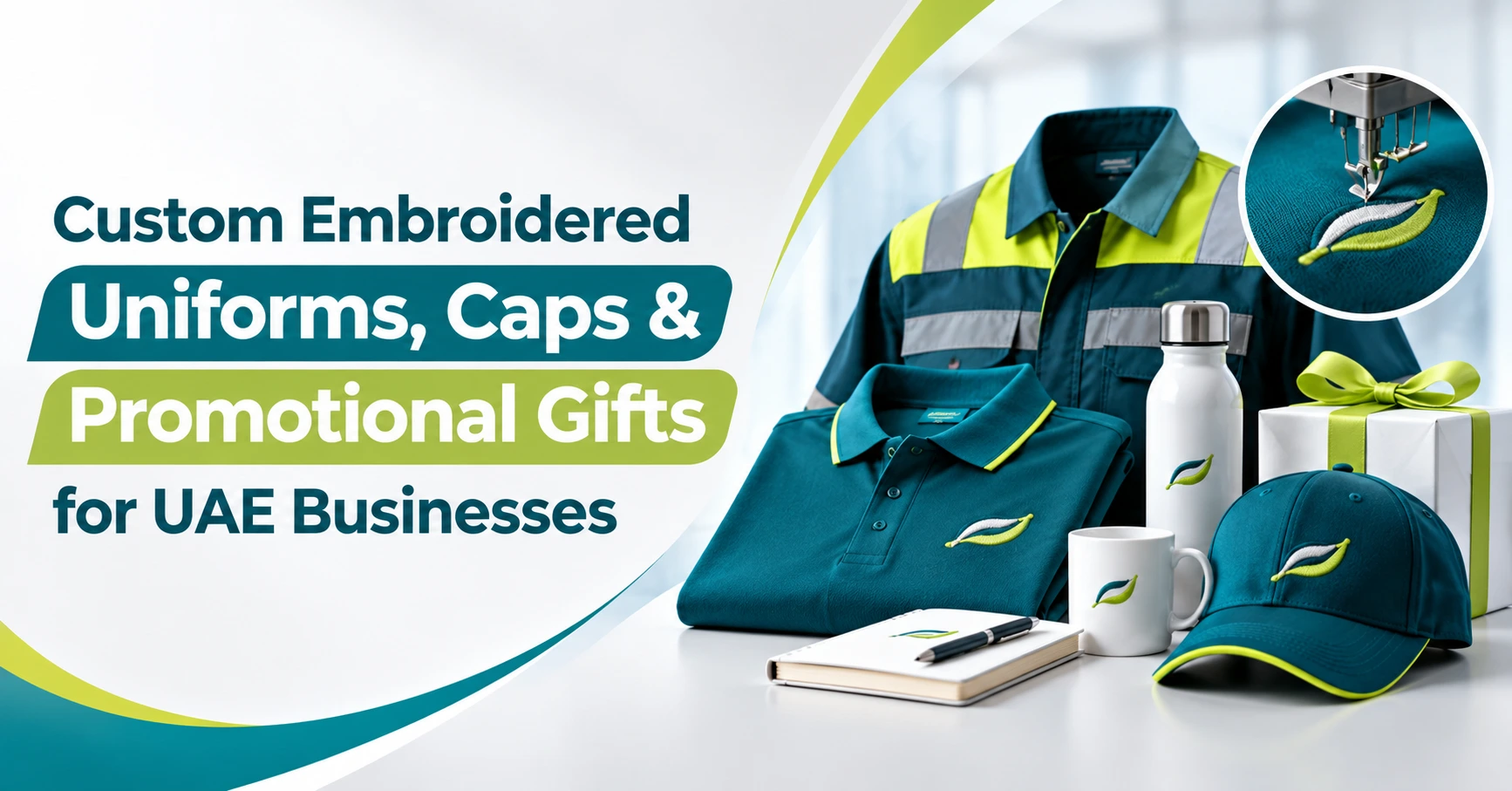
Custom Embroidered Uniforms, Caps & Promotional Gifts for UAE Businesses
Businesses looking for custom embroidery services in UAE often need more than company logos stitched onto employee uniforms. They may also require branded caps for outdoor teams, embroidered bags for corporate events and customised promotional gifts for customers, employees and business partners. Coordinating these products helps maintain a recognisable brand identity across different business activities.
However, choosing the right customisation method for every product is important. Embroidery works well on suitable fabrics such as cotton, polyester and blended textiles, while other promotional products may require logo printing or alternative personalisation methods.
For companies operating in the UAE, a well-planned branding order should consider the intended use, product material, logo design, embroidery placement, quantities and production requirements.
Whether you are preparing staff uniforms, exhibition merchandise, employee appreciation gifts or branded caps, the right approach can help create a consistent appearance across your products.
This guide explains how UAE businesses can plan custom embroidered uniforms, caps and promotional gifts, select suitable materials and choose appropriate branding methods for different products.
1. Why Should UAE Businesses Invest in Custom Embroidered Uniforms and Branded Merchandise?
A company’s visual identity should remain recognisable across employee clothing, customer-facing activities and promotional campaigns.
When uniforms, caps and selected merchandise follow consistent branding guidelines, businesses can create a coordinated appearance across different departments and customer interactions.
Custom embroidery adds a stitched design to suitable fabric products, allowing a company logo, name or approved artwork to become part of the garment or accessory.
Consistent Branding Across Employee Uniforms
Employees regularly represent a business during customer interactions, operational activities, meetings and events.
Embroidered company logos on shirts, jackets, polo shirts and other uniforms can help identify employees and maintain consistent branding across departments.
For companies with several teams or branches, using approved logo sizes, thread colours and placement specifications also makes repeat uniform orders easier to manage.
Branded Caps for Employees and Promotional Activities
Caps are another practical option for businesses looking to extend their visual identity beyond traditional uniforms.
They may be suitable for:
-
Outdoor employees.
-
Delivery and logistics teams.
-
Construction and site personnel.
-
Retail promotions.
-
Corporate events.
-
Sports activities and team events.
An embroidered company logo on the front or side of a cap can provide a coordinated appearance when worn alongside branded uniforms.
Promotional Gifts for Customers and Employees
Businesses also use customised merchandise for exhibitions, trade shows, product launches, employee appreciation events and customer engagement activities.
Depending on the product, branding options may include embroidery, printing or personalised text.
For example, fabric bags and caps may be suitable for embroidery, while pens, notebooks, mugs and power banks generally require other customisation methods.
Rafal Garments offers embroidery for uniforms, apparel, caps, bags and towels, alongside a separate collection of customised promotional gift products.
2. Which Uniforms Can Be Customised with Logo Embroidery?
The right uniform depends on the employee’s job role, working environment and the company’s visual identity.
Different industries require different garment styles, but a common branding approach can be maintained through consistent logo placement and thread colours.
Corporate Shirts and Polo Shirts
Corporate shirts and polo shirts are commonly used for office teams, sales representatives, retail employees and customer-facing staff.
Embroidery can be considered for:
-
Left-chest company logos.
-
Sleeve branding.
-
Employee names.
-
Department identification.
-
Selected collar branding.
A smaller embroidered logo is often suitable when the company wants understated branding on professional clothing.
Before selecting a design, check the fabric, garment thickness and logo dimensions to ensure that the embroidery sits comfortably.
Explore corporate uniform manufacturing for branded shirts, polos, trousers, jackets and other professional apparel.
Industrial and Workwear Uniforms
Industrial and operational employees may require garments designed around daily work activities.
Depending on the uniform type, branding can be applied to:
-
Work shirts.
-
Jackets.
-
Coveralls.
-
Industrial garments.
-
Selected workwear accessories.
For these garments, the embroidery position should not interfere with functional features or any required protective properties.
Important: Adding embroidery to workwear does not automatically make a garment certified PPE. Where protective clothing is involved, the manufacturer should confirm that customisation does not compromise its intended protective performance.
Hospitality and Medical Uniforms
Hotels, restaurants, clinics and healthcare facilities often use employee-specific uniforms.
Examples include:
-
Chef coats.
-
Hospitality shirts.
-
Reception uniforms.
-
Medical scrubs.
-
Lab coats.
-
Staff jackets.
Logo embroidery can help identify the organisation and, where appropriate, the department or employee name.
However, healthcare and hospitality garments should also be assessed for fabric suitability, washing requirements and placement comfort.
Sportswear and Team Apparel
Sports clubs, corporate teams and organisations conducting employee activities may require branded jerseys, tracksuits, jackets and caps.
Embroidery can be used for logos and selected identification elements, while printed branding may be more suitable for larger or complex designs.
Rafal’s embroidery service lists corporate, hospitality, medical, retail, educational and sports-team applications among its embroidery categories.
3. Custom Embroidered Caps: What Should Businesses Consider?
Caps are a useful addition to a corporate branding programme, particularly for teams working outdoors or participating in promotional activities.
However, cap embroidery requires attention to the shape, construction and available stitching area.
Choose the Right Cap Style
Different cap styles create different branding opportunities.
Baseball caps: Commonly selected for corporate events, outdoor teams and promotional activities.
Trucker caps: Feature a mesh rear section and are often considered for casual promotions and branded merchandise.
Structured caps: Have a reinforced front panel that helps maintain the cap’s shape and provides a suitable area for front-logo embroidery.
Unstructured caps: Have a softer construction and a more relaxed appearance.
The choice should match the company’s brand style and how the cap will be used.
Check the Front Panel Before Embroidery
The front panel is one of the most common locations for a company logo.
Before approving the design, consider:
-
Available embroidery space.
-
Cap panel construction.
-
Logo dimensions.
-
Embroidery density.
-
Thread colours.
-
Curvature of the front panel.
Very large or highly detailed logos may need adjustment to suit the available stitching area.
Consider Side and Rear Logo Placement
Businesses do not always need to place their logo only on the front of a cap.
Depending on the design, branding can also be positioned on:
-
Side panels.
-
Rear panels.
-
Above the fastening strap.
-
Other suitable fabric sections.
A smaller logo or company name can sometimes work better than an oversized design.
Match Caps with Employee Uniforms
For businesses ordering uniforms and caps together, maintain consistency through:
-
Approved brand colours.
-
Matching logo artwork.
-
Consistent thread colours.
-
Appropriate embroidery size.
-
Similar branding placement.
This creates a coordinated appearance when employees wear both items together.
Rafal lists embroidered caps among its corporate and promotional embroidery applications.
4. Which Promotional Gifts Can Be Customised for Business Branding?
Promotional merchandise gives businesses another way to present their branding outside regular employee uniforms.
The most suitable product depends on the recipient, campaign purpose, budget and intended use.
Fabric-Based Promotional Gifts
Certain promotional products can be customised using embroidery because they are made from suitable textile materials.
Examples include:
Tote bags: Suitable for exhibitions, conferences, shopping promotions and employee gifts.
Backpacks: Can be branded for corporate teams, educational activities or event merchandise, subject to the material and embroidery area.
Towels: May be considered for hospitality, employee recognition and selected corporate gift sets.
Caps: Can be customised with company logos for staff, promotional activities and team events.
Branded T-shirts: Embroidered logos or other suitable branding can be used depending on the design and garment material.
Other Corporate Promotional Gifts
Not every promotional gift requires embroidery.
Rafal’s promotional gift collection includes products such as:
-
Pens.
-
Wallets.
-
Notebooks and diaries.
-
USB devices.
-
Power banks.
-
Keychains.
-
Mugs.
-
Backpacks.
-
Umbrellas.
-
Files and folders.
-
Non-woven bags.
These items require branding methods suited to their material and construction. For example, printed logos or personalised text may be more appropriate for pens, mugs, notebooks and power banks.
The important point is to choose a branding process that suits the product instead of trying to use embroidery on every promotional item.
Explore custom promotional gift items for different product options.
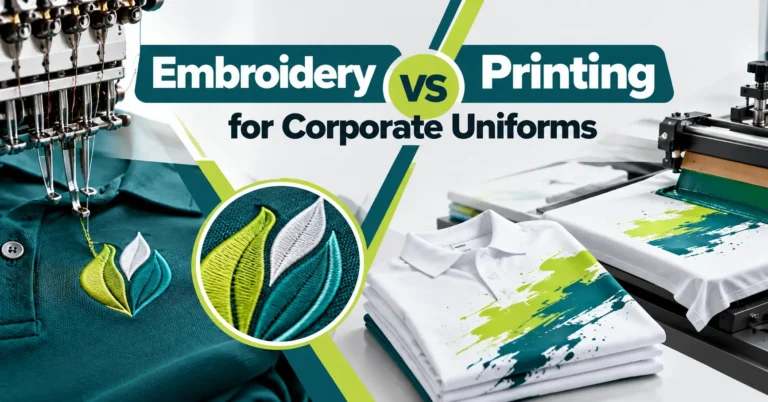
5. Embroidery vs Printing: Which Branding Method Should You Choose?
One of the most important decisions when ordering customised products is choosing between embroidery and printing.
Both techniques can support business branding, but they serve different purposes.
Custom Embroidery
Embroidery uses stitching to create a logo, name or design on a suitable fabric surface.
It is commonly selected for:
-
Corporate uniforms.
-
Polo shirts.
-
Jackets.
-
Workwear.
-
Caps.
-
Towels.
-
Fabric bags.
Its stitched appearance can provide a textured finish suitable for many professional apparel applications.
Printing Methods
Printing may be more appropriate when the logo contains complex colours, larger artwork or detailed graphic elements.
Common garment printing options include:
Screen printing: Suitable for selected bulk apparel orders and designs requiring consistent printed graphics.
DTF printing: Uses a printed transfer applied to compatible garments.
Heat-transfer printing: Applies a prepared design using heat and pressure, depending on the material and application.
Other product-specific printing: Used on promotional items such as pens, mugs, notebooks and other suitable merchandise.
Embroidery vs Printing Comparison
| Factor | Embroidery | Printing |
|---|---|---|
| Appearance | Stitched and textured | Printed surface design |
| Common applications | Uniforms, caps, jackets and bags | T-shirts, promotional products and larger graphics |
| Logo details | Works best with embroidery-adapted artwork | Can accommodate complex and multicolour designs, depending on method |
| Fabric suitability | Depends on fabric thickness and construction | Depends on printing method and material |
| Design size | Usually better for controlled logo dimensions | Can support larger designs on suitable products |
| Main consideration | Fabric, stitch quality and logo details | Artwork, surface and printing compatibility |
Which should you choose?
Select embroidery when you want a stitched logo on suitable fabric products such as uniforms, caps, jackets or towels.
Choose printing when the product material or artwork is better suited to a printed finish.
For an order containing different merchandise types, businesses can combine both techniques to maintain a consistent visual identity.
Rafal offers embroidery, screen printing, DTF printing and heat-transfer printing options depending on the product and design requirements.
6. Prepare Your Company Logo for Custom Embroidery
Good embroidery results begin with suitable artwork preparation.
A logo created for digital marketing or website use may need adjustments before it can be reproduced as stitching on fabric.
This is because embroidery machines translate artwork into a sequence of stitches rather than printing a complete image.
Provide Clear Logo Artwork
Where available, provide:
-
Vector logo files.
-
Approved brand colour references.
-
High-resolution artwork.
-
Logo proportions.
-
Text and symbol details.
-
Preferred placement.
Vector artwork can help with resizing and preparing the logo for digitisation.
Understand Embroidery Digitisation
Digitisation converts a visual logo into an embroidery-ready machine file.
During this process, the artwork is interpreted through stitch types, stitch direction, density and sequencing.
The design may need adjustments to account for:
-
Very small lettering.
-
Fine lines.
-
Complex shapes.
-
Closely spaced details.
-
Different fabric surfaces.
-
Cap panel curvature.
A logo that looks clear on a computer screen may need simplification to maintain legibility when stitched onto a small cap or uniform.
Match Thread Colours with Brand Guidelines
Thread selection is important for maintaining brand consistency.
Provide the approved brand colours and request a sample where colour accuracy is important.
Screen colours on a monitor and actual embroidery threads may look different under different lighting conditions. A physical thread sample can help with approval.
Approve Logo Placement Before Production
Decide where the logo should appear on each product.
| Product | Common branding location |
|---|---|
| Corporate shirt | Left chest or sleeve |
| Polo shirt | Left chest |
| Jacket | Chest or selected sleeve area |
| Cap | Front panel or side panel |
| Tote bag | Front-facing fabric area |
| Towel | Suitable corner or border area |
The final position should be checked against the actual product dimensions.
7. Match Fabrics and Materials with the Right Embroidery Technique
Not all fabrics behave in the same way during embroidery.
Some materials can support detailed stitched logos, while others may require stabilisation, adjusted stitch density or a different branding method.
Before production begins, check the material and construction of every product.
Cotton Fabrics
Cotton garments are frequently used for shirts, casual uniforms, towels and selected bags.
The fabric weight and weave should be considered when deciding the embroidery size and stitch density.
Polyester Fabrics
Polyester appears in many uniforms, sportswear products and promotional textiles.
The embroidery settings and stabilisation requirements should be suitable for the specific material.
Blended Fabrics
Poly-cotton and other blended materials are also commonly used in business apparel.
A sample test helps establish how the fabric responds during embroidery and washing.
Caps and Structured Materials
Caps require specific attention because their curved panels and reinforced front construction can affect embroidery positioning.
The design, stitching area and backing should be evaluated before production.
Practical tip: Approve a sample using the actual material and branding method rather than judging the result from a digital mockup alone.
8. How to Maintain Consistent Branding Across Uniforms, Caps and Gifts
When businesses order multiple customised items together, consistency should be managed across the entire order.
A logo embroidered on a shirt and a logo printed on a mug may use different production methods, but both should follow the same approved brand identity.
Maintain a Central Brand Reference
Create a single reference document that includes:
-
Approved logo artwork.
-
Brand colours.
-
Typography, where used.
-
Embroidery thread colours.
-
Logo dimensions.
-
Product-specific placement.
-
Printing specifications.
-
Packaging requirements.
This reduces the risk of different teams submitting different logo versions.
Use Product-Specific Artwork Adjustments
The complete logo may not work equally well on every product.
For example, a detailed company logo on a shirt might need a simplified version for a small cap embroidery area.
Likewise, a promotional mug may need a printed layout designed specifically for its curved surface.
Any variation should be approved and documented so the brand remains recognisable.
Review Samples from Different Product Categories
If your order contains uniforms, caps and gifts, do not approve only one product.
Request suitable samples for each major product type.
Check the embroidery and printing appearance separately while ensuring the overall branding remains coordinated.
9. Plan Bulk Orders for Corporate Uniforms, Caps and Promotional Gifts
Businesses ordering multiple customised items should prepare their quantity requirements before production.
This is particularly important for exhibitions, corporate events, employee onboarding and seasonal promotions.
Calculate Quantities by Product Category
Separate the order into different product groups.
| Product category | Information to confirm |
|---|---|
| Employee uniforms | Department, garment type and staff sizes |
| Corporate caps | Style, quantity and logo position |
| Fabric promotional gifts | Material, dimensions and branding method |
| Printed gifts | Product type, print area and artwork |
| Event merchandise | Event date, quantity and packaging |
| Employee appreciation gifts | Recipient count and personalisation requirements |
Set a Realistic Production Timeline
Custom production involves several stages, including artwork preparation, digitisation, sampling, approval and manufacturing.
For large orders, confirm the required delivery date before starting production.
This is particularly important when promotional gifts are intended for exhibitions, trade shows or scheduled corporate events.
Approve a Sample Before Bulk Production
A physical sample helps businesses review the finished product before approving the full order.
Check:
-
Fabric or product material.
-
Logo clarity.
-
Stitching or print finish.
-
Colour accuracy.
-
Product dimensions.
-
Branding position.
-
Overall appearance.
Keep an approved sample or documented reference for future orders.
10. What Should Businesses Check Before Choosing a Custom Embroidery Supplier?
Selecting a suitable supplier involves more than checking whether embroidery machines are available.
Businesses should assess the supplier’s ability to understand different products, prepare artwork, handle samples and manage bulk production.
Here are some useful questions to ask.
What products can be customised? Confirm whether the supplier handles uniforms, caps, bags, towels and other promotional items.
Which branding methods are available? Check whether embroidery, screen printing, DTF printing and product-specific customisation are offered.
Can the supplier prepare embroidery digitisation? Ask how logos are converted into machine-ready files.
Are physical samples available? Samples help businesses approve material, logo position and finishing before bulk orders.
Can different products be ordered together? If you need uniforms, caps and promotional gifts, check whether the supplier can coordinate the requirements.
How is bulk-order consistency maintained? Ask about artwork references, thread colours, sample approvals and final quality checks.
What are the production and delivery timelines? Confirm the expected schedule based on quantities, product types and event dates.
These questions help procurement and marketing teams compare suppliers more effectively.
11. Custom Embroidery and Promotional Products from Rafal Garments in Ajman
Rafal Garments Company LLC provides embroidery, customised uniforms and promotional gift services from its Ajman operation.
Its embroidery service lists applications for uniforms, corporate apparel, caps, bags, towels, sportswear and corporate gifts.
Custom Embroidery Services
Rafal’s published embroidery process includes:
-
Design evaluation and digitisation: Preparing the company logo or design in an embroidery-ready format.
-
Thread and fabric matching: Selecting thread colours and considering the material.
-
Sample approval: Discussing sampling options for larger or corporate orders.
-
Embroidery production: Carrying out stitching using embroidery equipment.
-
Quality inspection: Checking stitch consistency, alignment and finishing.
Businesses can request embroidery for suitable garments and fabric products based on the design and material requirements.
Custom Uniforms and Caps
Businesses can explore customised uniforms for corporate, hospitality, medical, industrial and other workplace applications.
Rafal’s corporate uniform collection includes shirts, trousers, suits, waistcoats, jackets, vests, polos, T-shirts, ties and caps. Branding options include embroidery and printing, depending on the garment.
Promotional Gift Items
Rafal’s promotional gift collection includes caps, bags, mugs, umbrellas, keychains, backpacks, diaries, files and folders, alongside other business merchandise.
Printing, embroidery and personalised text options depend on the product type.
For businesses planning a combined branding order, these product categories can be considered together.
Conclusion: Build a Consistent Brand with Custom Embroidered Uniforms, Caps and Gifts
Custom embroidered uniforms, caps and promotional gifts can support a coordinated business identity when their designs, colours and branding methods are planned together.
Start by identifying the products your business needs and the purpose of each item. Select suitable fabrics, prepare embroidery-ready artwork and decide where logos should appear. For promotional products made from different materials, choose the appropriate branding technique rather than using embroidery for every item.
Before approving bulk production, review physical samples, confirm quantities and document the final specifications.
For businesses looking for custom embroidery services in UAE, Rafal Garments Company LLC offers embroidery for uniforms, caps and selected fabric-based promotional products, alongside printing and customised merchandise options.
Planning Custom Embroidered Uniforms, Caps or Promotional Gifts for Your Business?
Explore Rafal’s custom embroidery services in Ajman and discuss your product choices, logo artwork, quantities and branding requirements.
Frequently Asked Questions
1. What products can be customised through embroidery?
Suitable textile products include corporate uniforms, shirts, polo shirts, jackets, caps, towels, bags and selected sportswear. The material and construction should be checked before approving embroidery.
2. Can a company logo be embroidered on uniforms and caps?
Yes. Company logos can be embroidered on suitable uniforms and caps. The design, stitch density, thread colour and placement should be adjusted according to the product size and material.
3. What is the difference between embroidered and printed promotional gifts?
Embroidery creates a stitched design on suitable fabric products such as caps, towels and bags. Printing applies a design to compatible surfaces and may be more appropriate for items such as mugs, pens, notebooks and power banks.
4. Which promotional gifts are suitable for embroidery?
Caps, textile bags, towels, selected apparel and other suitable fabric-based gifts can be considered for embroidery. Non-fabric merchandise generally requires printing or another suitable customisation method.
5. Can complex company logos be embroidered?
Many logos can be digitised for embroidery, but very small text, fine lines and intricate details may need adjustments. A sample helps confirm whether the design remains clear when stitched.
6. Is embroidery suitable for bulk corporate uniform orders?
Yes. Embroidery can be used for bulk orders of corporate uniforms and branded apparel. Maintaining approved artwork, thread colours, logo placement and production references helps improve consistency across the order.
7. How can businesses maintain consistent branding across uniforms and promotional gifts?
Use the same approved logo artwork, brand colours and design references. Choose product-specific embroidery or printing methods while keeping the overall visual identity consistent.
8. Can businesses order uniforms, caps and promotional gifts together?
Businesses can discuss combined branding requirements for uniforms, caps and promotional products. Product quantities, materials and branding methods should be confirmed separately before production.
9. Does Rafal Garments offer custom embroidery for promotional gifts?
Yes. Rafal lists embroidery for selected promotional items, including caps, bags, towels and fabric-based products. It also provides printing and personalised text options for other promotional gift types.
10. Where can businesses get custom embroidery services in Ajman?
Rafal Garments Company LLC provides custom embroidery services in Ajman for uniforms, corporate apparel, caps, bags, towels, sportswear and suitable promotional products. Businesses can share their artwork, product preferences and order quantities to discuss their requirements.