T-Shirt Manufacturing in Ajman: From Fabric Selection to Finished Garments
A finished T-shirt may look simple, but producing a well-made garment involves several carefully connected stages. From choosing the right fabric and creating the pattern to cutting, stitching, printing, finishing and quality inspection, every step can influence the final fit, appearance and performance of the T-shirt.
For businesses looking for T-shirt manufacturing in Ajman, understanding this process can make it easier to choose the right manufacturer and specify the right product for their requirements.
A corporate T-shirt may need to be comfortable enough for employees to wear throughout the working day. A promotional T-shirt may prioritize cost-effective bulk production and strong branding. Sportswear may require lightweight, moisture-managing fabric, while retail apparel may require more attention to fit, finishing and design details.
That is why professional T-shirt manufacturing is not simply about putting a logo on a ready-made shirt.
It begins with understanding the purpose of the garment and selecting the right combination of fabric, construction, printing and finishing.
What Is T-Shirt Manufacturing?
T-shirt manufacturing is the process of converting textile fabric into a finished T-shirt according to a specific design, size, fit and production requirement.
Depending on the project, the process can include:
- Requirement planning
- Fabric selection
- Design and specification
- Pattern development
- Fabric inspection
- Cutting
- Size grading
- Stitching
- Printing or embroidery
- Finishing
- Quality inspection
- Folding and packaging
- Delivery
The exact production workflow can vary depending on the garment style, fabric, order quantity, customization and manufacturing requirements.
Step 1: Understanding the T-Shirt Requirement
Before fabric is selected, the manufacturer needs to understand what the T-shirt is being produced for.
This is an important first step because different applications require different garment specifications.
For example:
Corporate T-Shirts
Companies may require T-shirts for employees, promotional activities, exhibitions or branded workwear.
Important considerations can include:
- Company logo
- Brand colors
- Employee comfort
- Consistent sizing
- Fabric durability
- Logo placement
- Quantity
- Reorder requirements
Promotional T-Shirts
Promotional T-shirts are commonly produced for:
- Marketing campaigns
- Product launches
- Exhibitions
- Trade shows
- Events
- Brand activations
For these orders, print visibility, quantity and production cost may be particularly important.
Sports and Performance T-Shirts
Sportswear may require lightweight and breathable materials, suitable construction and printing methods that work with performance fabrics.
Retail or Fashion T-Shirts
Retail garments may require more attention to:
- Fit
- Fabric hand feel
- Style
- Color
- Stitching
- Labels
- Finishing
- Packaging
Defining the purpose before production helps the manufacturer recommend appropriate materials and construction.
Step 2: Choosing the Right Fabric
Fabric selection is one of the most important decisions in T-shirt manufacturing.
The fabric affects the garment’s:
- Comfort
- Weight
- Breathability
- Appearance
- Durability
- Stretch
- Print compatibility
- Washing performance
- Overall cost
Common T-shirt fabric options include cotton, polyester and blended fabrics.
Cotton T-Shirts
Cotton is widely used for everyday apparel because of its familiar feel and breathability.
Cotton T-shirts can be suitable for:
- Corporate casual wear
- Promotional apparel
- Events
- Retail clothing
- Everyday uniforms
However, the characteristics of a cotton T-shirt depend on factors such as fabric construction, GSM, yarn and finishing.
Polyester T-Shirts
Polyester is commonly used when durability, lightweight construction or performance characteristics are important.
It is frequently considered for:
- Sportswear
- Outdoor teams
- Performance apparel
- Promotional garments
The printing method should also be selected according to the fabric composition.
Cotton-Polyester Blends
Blended fabrics combine characteristics of different fibres.
A cotton-polyester blend can provide a balance between comfort, durability and garment performance, depending on the specific blend and construction.
Dri-Fit and Performance Fabrics
For sports and active environments, performance-oriented fabrics may be preferred.
The correct material should be selected according to:
- Activity level
- Climate
- Indoor or outdoor use
- Required comfort
- Branding method
- Expected washing frequency
What Is GSM in T-Shirt Fabric?
GSM means grams per square metre.
It is commonly used to describe the weight of a fabric.
A lower GSM generally indicates a lighter fabric, while a higher GSM generally indicates a heavier fabric.
However, GSM alone does not determine whether a T-shirt is better.
The right GSM depends on the intended application.
For example:
- Lightweight T-shirts may be suitable for hot-weather promotional use.
- Medium-weight fabrics may work well for everyday corporate apparel.
- Heavier fabrics may be preferred for certain premium or fashion-oriented garments.
A manufacturer should consider GSM together with fibre composition, construction, fit and intended use.
Step 3: Creating the T-Shirt Design and Specifications
Once the material requirements are understood, the manufacturer can finalize the garment specifications.
These may include:
- T-shirt style
- Neck type
- Sleeve length
- Body fit
- Fabric type
- Fabric color
- GSM
- Logo placement
- Print size
- Print colors
- Labels
- Packaging requirements
For corporate orders, the company should provide its logo and brand guidelines where available.
A vector logo file such as AI, EPS or PDF can help maintain artwork quality during production.
Step 4: Pattern Making
The pattern determines the shape and dimensions of the garment pieces.
A typical T-shirt pattern can include sections such as:
- Front body
- Back body
- Sleeves
- Neck rib
- Other required components
The pattern must account for the required size, fit and garment construction.
For multiple sizes, the manufacturer may create graded patterns so that the proportions change appropriately from one size to another.
This is particularly important for bulk corporate orders where employees may require a range of sizes.
Step 5: Fabric Inspection
Before cutting, the fabric should be checked for potential issues.
Depending on the manufacturing process, inspection may look for:
- Visible defects
- Color inconsistencies
- Fabric damage
- Uneven texture
- Contamination
- Width variations
- Shade differences
Identifying problems before cutting can reduce the risk of defects appearing across finished garments.
For larger orders, consistency between fabric batches is also important.
Step 6: Fabric Cutting
Once the pattern and fabric are approved, the fabric is cut according to the required garment pieces.
Accurate cutting is important because even small inconsistencies can affect:
- Garment dimensions
- Symmetry
- Fit
- Sleeve alignment
- Production efficiency
For bulk T-shirt manufacturing, multiple layers of fabric may be arranged and cut together using suitable production equipment.
The cutting stage therefore connects the design specifications with the physical garment components.
Step 7: Size Grading and Production Planning
A bulk T-shirt order rarely consists of one size.
A corporate order might include:
- XS
- S
- M
- L
- XL
- XXL
- Larger sizes where required
The manufacturer needs to manage the size ratio accurately according to the customer’s order.
For large projects, production planning also needs to account for:
- Total quantity
- Color variations
- Size breakdown
- Fabric availability
- Printing requirements
- Delivery deadline
Clear specifications at this stage can reduce errors later in production.
Step 8: Stitching the T-Shirt
After cutting, the fabric components move into garment assembly.
The individual pieces are stitched together according to the approved construction.
Typical areas include:
- Shoulder seams
- Side seams
- Sleeve attachment
- Neck construction
- Sleeve hems
- Bottom hem
Different sewing and overlock processes may be used depending on the garment design.
The objective is to create a consistent structure while maintaining the required fit and finish.
Why Stitching Quality Matters
A T-shirt can have an attractive print and still perform poorly if the garment construction is inconsistent.
Problems can include:
- Uneven seams
- Loose threads
- Poorly attached sleeves
- Uneven hems
- Incorrect sizing
- Weak seam construction
For corporate and workwear orders, construction quality becomes particularly important because the garments may be worn repeatedly.
Step 9: Neck and Hem Finishing
The neck is one of the most visible construction areas on a T-shirt.
Depending on the design, manufacturers may use different neckline constructions such as:
- Crew neck
- V-neck
- Polo-style collar
- Other customized neck designs
The bottom and sleeve hems also require consistent finishing.
Good finishing contributes to the overall appearance and helps create a more consistent garment across a bulk order.
Step 10: Printing and Branding
Once the garment construction is ready, the T-shirt can be customized with logos, artwork, text or other graphics.
The appropriate printing method depends on factors such as:
- Fabric composition
- Design complexity
- Number of colors
- Order quantity
- Print location
- Required appearance
- Production timeline
Common T-shirt customization methods include:
Screen Printing
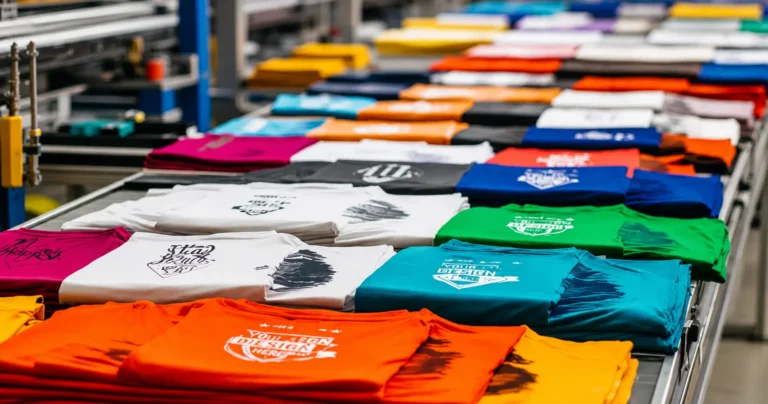
Screen printing is widely used for larger production runs.
It can be suitable for:
- Corporate T-shirts
- Promotional campaigns
- Event apparel
- Large logo orders
DTF Printing
Direct-to-Film printing can be useful for detailed, multi-color artwork and a variety of garment applications.
It is often considered when the design contains multiple colors, gradients or detailed graphics.
DTG Printing
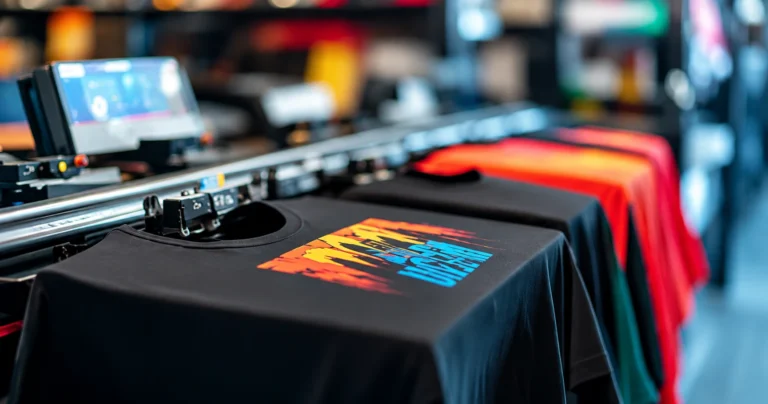
Direct-to-Garment printing applies ink directly onto suitable garments and can be useful for detailed full-color designs.
Heat Transfer
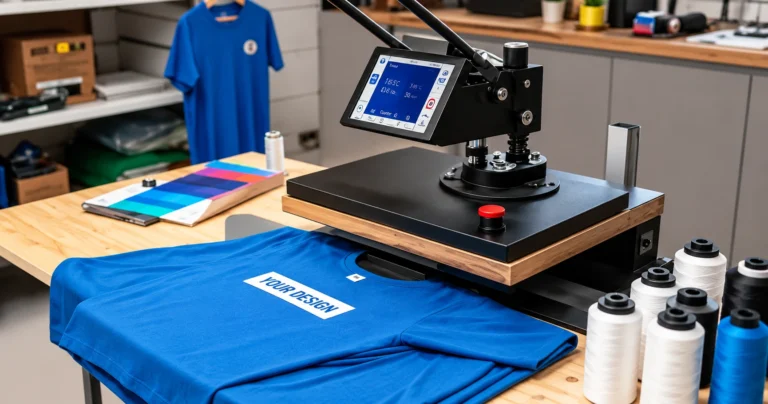
Heat-transfer methods can be suitable for certain logos, names, numbers and smaller customized orders.
Sublimation
Dye sublimation is commonly associated with polyester-based garments and can be useful for sportswear and all-over designs.
Embroidery
Embroidery is not technically a printing method, but it is an important garment customization option.
It can be particularly suitable for:
- Corporate logos
- Premium workwear
- Polo shirts
- Uniforms
- Caps and other apparel
The best method depends on the fabric and the actual design rather than choosing one technique for every order.
Step 11: Print Quality Inspection
Branding needs to be checked after printing.
The manufacturer may inspect:
- Logo position
- Color accuracy
- Print alignment
- Print coverage
- Edges
- Surface defects
- Consistency between garments
For corporate orders, accurate logo placement matters because every employee’s garment should present the brand consistently.
Step 12: Final Garment Inspection
Before delivery, finished garments should go through final inspection.
A quality-control process may check:
Fabric
Is the fabric consistent with the approved specification?
Stitching
Are seams, hems and sleeves properly constructed?
Sizing
Does the garment match the required size specification?
Printing
Is the logo correctly positioned and reproduced?
Finishing
Are loose threads, stains or visible production defects removed?
Quantity
Does the completed order match the requested quantity and size breakdown?
Final inspection helps identify issues before the garments reach the customer.
Step 13: Folding, Packaging and Delivery
After quality checks, the finished T-shirts can be folded, packed and prepared for delivery.
For corporate orders, packaging and labeling may also need to follow the customer’s requirements.
For example, garments may be organized according to:
- Size
- Color
- Department
- Employee
- Product code
- Order batch
This can make distribution easier when the T-shirts are delivered to a business with many employees.
How Long Does T-Shirt Manufacturing Take in Ajman?
Production time depends on several factors rather than one fixed number.
Important variables include:
- Order quantity
- Fabric availability
- T-shirt style
- Number of colors
- Printing method
- Artwork complexity
- Sampling requirements
- Size variations
- Finishing requirements
- Delivery location
A small customized order may follow a different production schedule from a large corporate project involving hundreds or thousands of garments.
For this reason, businesses should confirm the production timeline with the manufacturer before approving the order.
If the T-shirts are required for an exhibition, product launch or corporate event, provide the deadline at the quotation stage.
What Affects the Cost of T-Shirt Manufacturing in Ajman?
There is no single price for custom T-shirt manufacturing.
The total cost can depend on:
Fabric
Different fabrics and GSM specifications have different costs.
Quantity
Bulk production can change the per-piece manufacturing cost.
Printing
The printing method, number of colors, print size and number of print locations can affect the final price.
Garment Construction
Customized fits, collars, sleeves or other construction details may increase production requirements.
Packaging
Individual packaging, labeling or special packing requirements can affect the overall quotation.
Delivery
The delivery location and order requirements may also influence logistics costs.
For an accurate quotation, provide the manufacturer with as much information as possible instead of requesting a price based only on the phrase “custom T-shirts.”
What Information Should You Give a T-Shirt Manufacturer?
A clear production brief can make the quotation and manufacturing process much smoother.
Include:
- T-shirt quantity
- Fabric preference
- GSM requirement
- T-shirt color
- Size breakdown
- Logo or artwork
- Printing method preference, if known
- Print locations
- Required delivery date
- Delivery location
- Packaging requirements
- Special customization requirements
If you are unsure about the printing method or fabric, ask the manufacturer to recommend an option based on the intended use.
T-Shirt Manufacturing for Different Industries in Ajman
T-shirts can be manufactured for a wide range of business applications.
Corporate Offices
Branded T-shirts can be used for staff activities, casual corporate uniforms, events and promotional campaigns.
Hospitality
Hotels, cafés and restaurants may require branded garments for front-of-house or operational teams.
Retail
Retail businesses can use customized T-shirts to help customers identify employees and maintain consistent branding.
Logistics and Delivery
Field teams may need comfortable branded garments that can withstand regular use.
Construction and Industrial Businesses
T-shirts can form part of broader workwear requirements, particularly when combined with other protective or uniform garments.
Schools and Educational Institutions
Customized T-shirts can be used for events, sports activities, clubs and institutional programs.
Events and Exhibitions
Event organizers may require branded T-shirts for staff, volunteers, participants or promotional campaigns.
Sports Teams
Performance-oriented fabrics and suitable printing methods can be selected according to the activity and garment requirements.
Why Choose T-Shirt Manufacturing in Ajman?
For businesses operating in Ajman and nearby Emirates, local manufacturing can offer practical advantages.
These may include:
- Easier communication
- Faster sample review
- Local quality inspection
- Simplified reorders
- Shorter local delivery routes
- Easier coordination for bulk orders
Ajman is also close to major UAE commercial markets, making local garment production useful for businesses that need apparel delivered across Ajman, Sharjah and Dubai.
However, location should not be the only factor when choosing a manufacturer.
Production capability, fabric options, customization methods, quality control and delivery reliability should also be evaluated.
What Should You Check Before Choosing a T-Shirt Manufacturer?
Before placing a bulk order, ask the manufacturer:
1. Can I see previous work?
Samples and completed projects can help you evaluate garment construction and print quality.
2. Can I check the fabric before production?
A fabric sample can help confirm weight, texture, color and suitability.
3. Do you provide a sample garment?
A physical sample can reveal issues that may not be obvious from a digital mockup.
4. Which printing methods do you offer?
A manufacturer with multiple customization options can recommend a method based on the garment and artwork.
5. Can you handle my quantity?
Make sure the production capacity matches your order volume and deadline.
6. Can you maintain consistent sizing and branding?
Consistency becomes particularly important for large corporate orders.
7. What is the production timeline?
Confirm the expected manufacturing and delivery schedule before approval.
8. What happens if there is a production issue?
Ask about inspection, corrections, replacement and reordering procedures.
T-Shirt Manufacturing vs T-Shirt Printing: What Is the Difference?
The terms are sometimes used interchangeably, but they can describe different services.
T-shirt printing generally means applying a design, logo or graphic to an existing garment.
T-shirt manufacturing involves producing the garment itself, from fabric and construction through finishing.
A manufacturer offering both capabilities can potentially coordinate:
Fabric → Garment Production → Printing → Quality Check → Finished T-Shirt
This can simplify the process for businesses ordering customized apparel in larger quantities.
T-Shirt Manufacturing in Ajman with Rafal Garments Company LLC
Rafal Garments Company LLC provides garment manufacturing and customized apparel solutions in Ajman for corporate and industrial requirements.
Its current service offering includes T-shirt printing and manufacturing, with customization options such as screen printing, DTF, DTG, heat transfer, embroidery and sublimation. The company also describes applications across hospitality, retail, logistics, healthcare, construction and educational institutions.
For businesses planning a custom T-shirt order, the project can be discussed around factors such as:
- Fabric type
- T-shirt style
- Quantity
- Size breakdown
- Logo placement
- Printing technique
- Branding requirements
- Delivery schedule
Rafal is located in Ajman Industrial 2, United Arab Emirates, and its current contact page provides phone and email options for product enquiries, quotations and custom orders.
If you are ordering for a corporate team, event, promotional campaign or industrial workforce, providing a detailed production brief can help the manufacturer recommend an appropriate combination of fabric, garment construction and branding method.
Final Checklist Before Starting T-Shirt Production
Before approving a T-shirt manufacturing order, confirm:
- Fabric type
- Fabric GSM
- T-shirt style
- Size chart
- Size quantity breakdown
- Garment color
- Logo artwork
- Logo placement
- Printing method
- Print dimensions
- Sample approval
- Total quantity
- Production deadline
- Packaging requirements
- Delivery location
- Final quality-check process
A clear checklist reduces misunderstandings between the customer and manufacturer.
Frequently Asked Questions
What is involved in T-shirt manufacturing?
T-shirt manufacturing can involve requirement planning, fabric selection, pattern development, cutting, size grading, stitching, printing or embroidery, finishing, quality inspection, packaging and delivery.
Which fabric is best for T-shirts?
There is no single fabric that is best for every application. Cotton may suit everyday and corporate apparel, polyester can work well for sports and performance garments, and blended fabrics can provide a balance of different characteristics.
What is GSM in T-shirt manufacturing?
GSM means grams per square metre and describes the weight of the fabric. The appropriate GSM depends on the intended use, garment style, climate and desired feel.
Which printing method is best for corporate T-shirts?
The appropriate method depends on the artwork, fabric, order quantity and required finish. Screen printing can work well for bulk orders, while DTF, DTG, heat transfer or other methods may be more suitable for particular designs and quantities.
Can T-shirts be manufactured and printed by the same company?
Yes. Some garment manufacturers provide both garment production and customization. This can allow the fabric, garment construction and branding process to be coordinated through one production workflow.
Can I order custom T-shirts in bulk in Ajman?
Yes. Custom T-shirt manufacturers can produce bulk orders for corporate uniforms, promotional campaigns, events, schools, sports teams and other business requirements. The available quantity and production timeline should be confirmed with the manufacturer.
How long does T-shirt manufacturing take?
Production time depends on quantity, fabric availability, design complexity, printing method, sampling, garment specifications and delivery requirements. Always confirm the timeline before approving production.
Can a manufacturer help choose the fabric?
Yes. If you are unsure which fabric to use, provide information about the intended application, climate, expected wear and budget. The manufacturer can then recommend suitable options.
What should I provide when requesting a T-shirt manufacturing quotation?
Provide the quantity, fabric preference, GSM if known, T-shirt style, colors, size breakdown, logo or artwork, print locations, required delivery date and any special packaging or customization requirements.
Does Rafal Garments Company LLC provide T-shirt printing and manufacturing in Ajman?
Yes. Rafal Garments Company LLC currently offers T-shirt printing and manufacturing services in Ajman, including multiple printing and customization options for corporate and other apparel requirements.
Conclusion
A finished T-shirt represents much more than a piece of printed fabric.
The manufacturing process begins with understanding the purpose of the garment and selecting suitable fabric. It then moves through pattern development, cutting, stitching, customization, finishing and quality inspection before the finished garments are packaged and delivered.
For businesses looking for T-shirt manufacturing in Ajman, understanding these stages makes it easier to ask the right questions, compare manufacturers and create a production brief that matches the intended use.
Whether the requirement is for corporate apparel, promotional T-shirts, event clothing, sportswear or branded workwear, the right combination of fabric, construction and customization can make a significant difference to the finished garment.
For a custom T-shirt manufacturing project in Ajman, start with your quantity, fabric requirements, design, size breakdown and delivery deadline, then work with the manufacturer to finalize the production specifications.