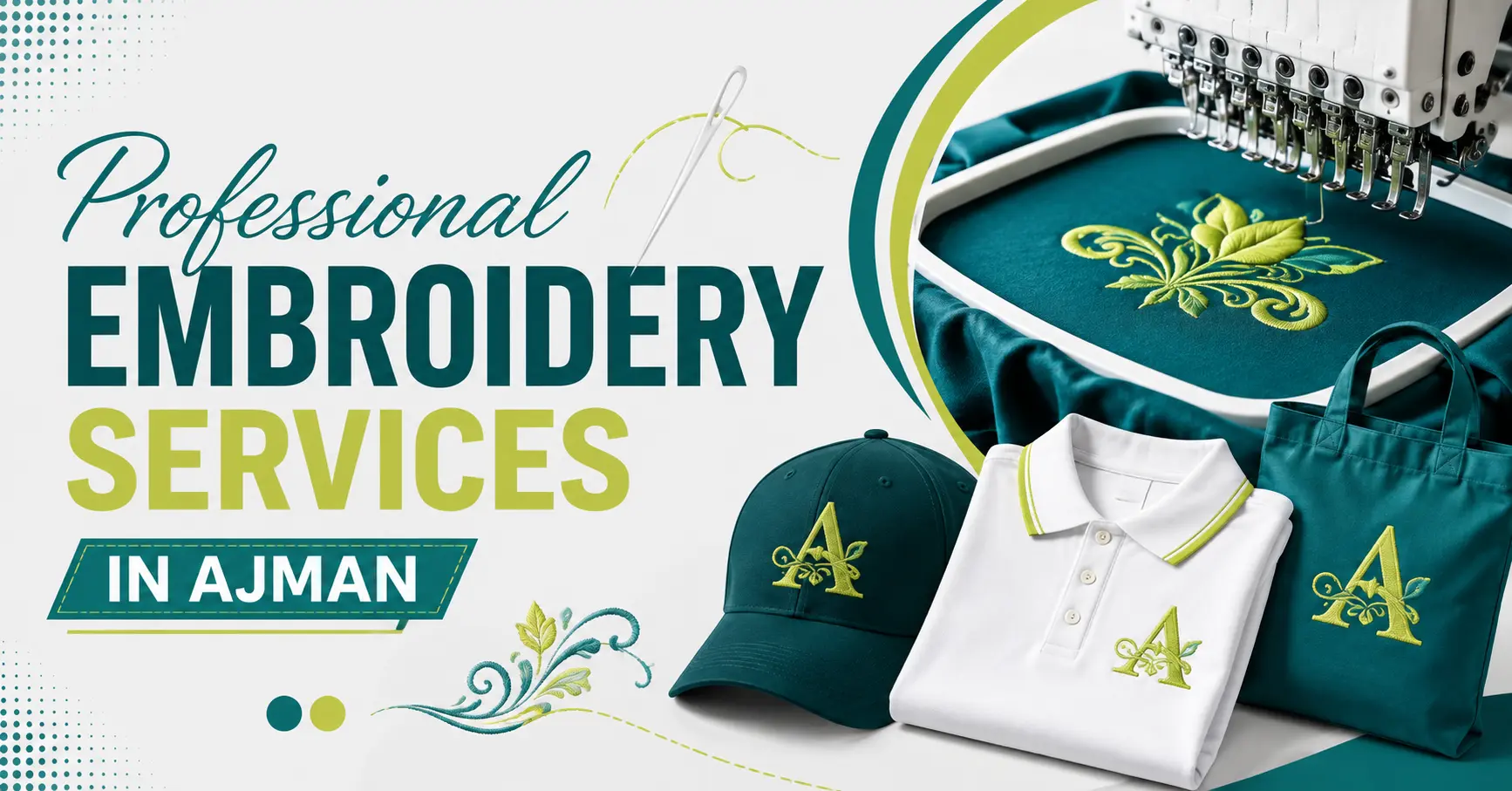
Professional Embroidery Services for Businesses in Ajman, UAE
Professional embroidery helps businesses add a consistent and durable branded finish to uniforms, workwear and other garments. A company logo, department name or other approved design can be embroidered onto selected clothing to support brand identification and create a more coordinated appearance for employees.
For businesses in Ajman and across the UAE, embroidery requirements can vary widely. A small business may need branded uniforms for a team of employees, while a larger organisation may require embroidery across workwear, hospitality uniforms, corporate apparel or promotional garments.
Choosing the right professional embroidery service involves more than sending a logo and selecting a garment. Businesses should consider embroidery quality, design suitability, thread colours, garment compatibility, logo placement, order quantity and production requirements.
This guide explains what businesses should look for when choosing professional embroidery services in Ajman.
What Are Professional Embroidery Services?
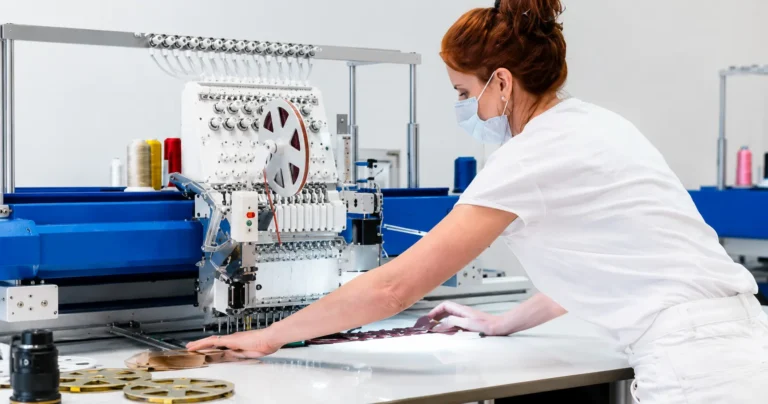
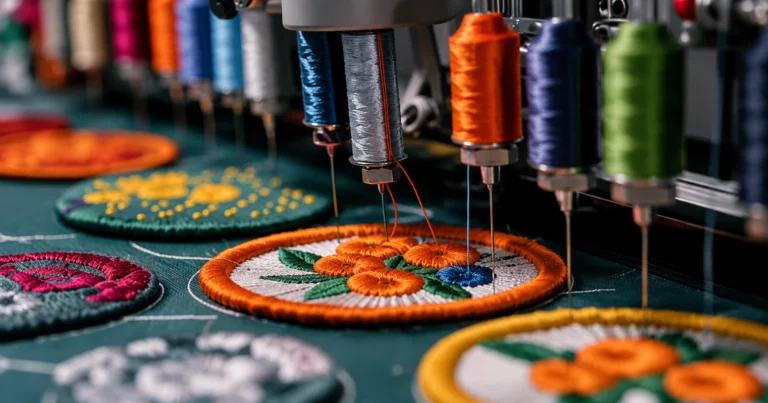
Professional embroidery is the process of stitching a design, logo, text or other artwork directly onto fabric using specialised embroidery equipment.
For businesses, embroidery is commonly used for:
- Company uniforms
- Corporate shirts
- Polo shirts
- T-shirts
- Workwear
- Hospitality uniforms
- Restaurant uniforms
- Healthcare uniforms
- School uniforms
- Caps and headwear
- Promotional apparel
The finished result depends on several factors, including the quality of the artwork, digitisation, thread selection, fabric type, embroidery machine settings and production process.
Why Do Businesses Use Embroidery for Uniforms?
Embroidery is widely used for business uniforms because it creates a stitched design that becomes part of the garment.
Depending on the garment and embroidery process, businesses may choose embroidery for:
Brand Identification
A company logo on employee uniforms can make staff easier to identify.
Consistent Appearance
Using the same approved logo placement, thread colours and garment style can help maintain consistency across employee clothing.
Suitability for Different Industries
Embroidery can be used on a variety of garments, including corporate shirts, polo shirts, jackets, workwear and hospitality uniforms.
Long-Term Use
The durability of embroidery depends on factors such as the fabric, thread, stitch construction, garment care and frequency of use.
For this reason, businesses should choose the embroidery method and garment combination based on the intended application.
What Should Businesses Check Before Choosing an Embroidery Service?
Before placing an order, consider the following factors.
1. Logo Quality and Artwork Preparation
The embroidery process usually begins with the artwork.
A business logo may need to be prepared or digitised into a format suitable for embroidery machinery.
The original logo should ideally be provided in a high-quality format.
Useful artwork formats may include:
- AI
- EPS
- SVG
- High-resolution PNG
The embroidery provider may advise whether changes are needed to make the design suitable for stitching.
Small details, thin lines and very small text may not always reproduce exactly as they appear in a printed logo.
2. Embroidery Digitisation
Digitisation is an important part of professional embroidery.
This process converts a design into stitch instructions that guide the embroidery machine.
A properly prepared embroidery file can help determine:
- Stitch direction
- Stitch density
- Design sequence
- Colour changes
- Underlay stitching
The same visual logo may require different embroidery settings depending on the fabric and garment.
For example, a design embroidered on a lightweight polo shirt may require a different approach from the same design applied to thicker workwear.
3. Garment and Fabric Type
Not every garment behaves the same way during embroidery.
Before production, consider:
- Fabric thickness
- Fabric stretch
- Garment construction
- Embroidery location
- Intended use
- Washing requirements
Common garments used for embroidery include:
- Cotton shirts
- Polyester uniforms
- Polo shirts
- Jackets
- Workwear
- Caps
- Aprons
The embroidery method should be suitable for the selected material.
4. Logo Placement
Logo placement affects both appearance and practicality.
Common embroidery positions include:
- Left chest
- Right chest
- Sleeve
- Back
- Collar
- Cap front
For corporate uniforms, the left chest is often selected for company branding, while sleeves or backs may be used for additional text or branding.
Before starting production, confirm:
- Exact placement
- Design size
- Distance from seams or pockets
- Consistency across garment sizes
5. Thread Colours
Thread colour selection is important for brand consistency.
Where possible, businesses should provide:
- Brand colour references
- Logo guidelines
- Approved artwork
- Existing uniform samples
Thread colours may need to be matched as closely as possible to the intended design.
A sample or approval process can help avoid unexpected colour differences during bulk production.
6. Embroidery Size and Detail
A detailed logo may need to be simplified when embroidered at a small size.
Very small text and complex elements can become difficult to reproduce clearly.
Before approving production, check:
- Readability
- Stitch clarity
- Logo proportions
- Small details
- Text size
A professional provider should assess whether the artwork is suitable for the selected embroidery size.
Which Businesses Can Benefit from Professional Embroidery?
Professional embroidery can be used across many industries.
Corporate Offices
Corporate businesses may use embroidered shirts, polo shirts and jackets for:
- Employee uniforms
- Events
- Exhibitions
- Corporate promotions
Hospitality Businesses
Hotels, restaurants and catering businesses may use embroidery for:
- Chef uniforms
- Service staff clothing
- Aprons
- Front-office uniforms
- Branded caps
Construction and Industrial Companies
Embroidery may be used on:
- Work shirts
- Jackets
- Safety-related workwear
- Staff uniforms
The selected garment should always be appropriate for the workplace and any applicable safety requirements.
Healthcare and Service Businesses
Clinics, service companies and other organisations may use embroidered uniforms to identify staff and departments.
Schools and Educational Institutions
Embroidery can be used for:
- School uniforms
- Staff clothing
- Sportswear
- Club apparel
Retail and Promotional Teams
Branded apparel can help identify employees during:
- Product promotions
- Exhibitions
- Events
- Retail campaigns
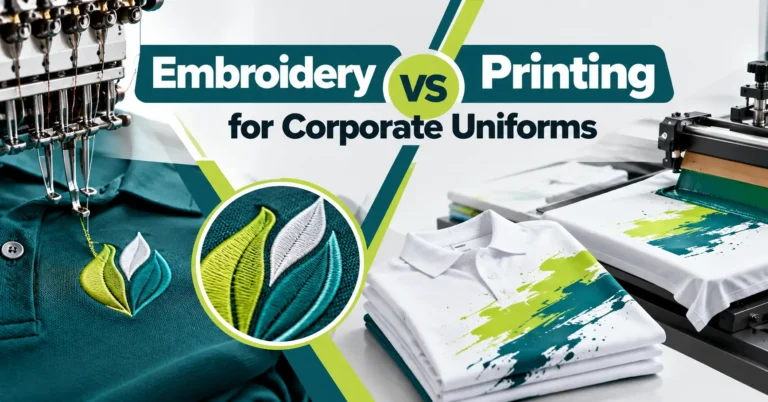
Embroidery vs Printing: Which Is Better for Business Uniforms?
The answer depends on the garment, design and intended use.
Embroidery May Be Suitable When:
- A stitched finish is preferred
- The design is relatively simple
- The logo is placed on the chest, sleeve or cap
- The garment is used as a regular uniform
- A textured branded appearance is required
Printing May Be Suitable When:
- The design contains complex graphics
- The artwork includes gradients
- Large designs are required
- Fine visual details are important
- A lightweight finish is preferred
In some cases, businesses may use both embroidery and printing on different garments or parts of the same uniform programme.
The right choice depends on the specific design and application.
How Does the Professional Embroidery Process Work?
A typical business embroidery process may include the following stages.
Step 1: Share Your Requirements
The business provides details such as:
- Logo or artwork
- Garment type
- Quantity
- Embroidery location
- Required size
- Colour requirements
Step 2: Artwork Review
The design is reviewed to determine whether it is suitable for embroidery.
Changes may be recommended if very small details cannot be reproduced effectively.
Step 3: Digitisation
The approved design is converted into an embroidery-ready format.
Step 4: Sample or Design Approval
For larger orders, reviewing a sample or approved design layout can help confirm:
- Size
- Position
- Colour
- Overall appearance
Step 5: Production
After approval, embroidery is completed according to the agreed requirements.
Step 6: Quality Check
Finished garments should be checked for:
- Correct logo placement
- Stitch consistency
- Thread colour
- Garment condition
- Overall presentation
How to Choose an Embroidery Service in Ajman
When comparing embroidery providers, avoid making a decision based only on price.
Ask practical questions.
What Type of Garments Can You Embroider?
Confirm whether the provider can work with your selected garments.
Can You Handle Bulk Uniform Orders?
If your business requires uniforms for multiple employees, discuss production capacity and lead times.
Can You Help With Logo Digitisation?
Ask whether the provider can prepare your logo for embroidery.
Can I Approve a Sample Before Bulk Production?
For larger orders, sample approval can help confirm the expected result.
What Information Do You Need Before Starting?
A professional provider should be able to explain the artwork, garment and production information required.
What Is the Expected Production Timeline?
Production time can depend on:
- Order quantity
- Garment availability
- Design complexity
- Number of embroidery locations
- Current production schedule
Confirm the expected timeline before placing the order.
Common Mistakes Businesses Make When Ordering Embroidered Uniforms
Sending Low-Quality Artwork
A blurry or low-resolution logo can make artwork preparation more difficult.
Whenever possible, provide the original logo file.
Choosing a Design That Is Too Detailed
Very fine details may not remain clear when stitched at a small size.
Not Checking the Final Placement
A logo may look different depending on garment size and construction.
Confirm the placement before bulk production.
Ignoring Fabric Compatibility
Different fabrics require different embroidery approaches.
Ordering Without Sample Approval
For larger orders, reviewing a sample or approved layout can help reduce the risk of production misunderstandings.
Choosing Only Based on the Lowest Price
Compare:
Embroidery preparation + garment quality + production capability + design accuracy + lead time
This gives businesses a more complete basis for comparison.
How Can Businesses Maintain Brand Consistency With Embroidery?
Businesses that regularly order uniforms should create a simple embroidery specification.
This may include:
- Approved logo file
- Approved thread colours
- Logo size
- Placement measurements
- Approved garment types
- Embroidery locations
Keeping these details documented can make future orders more consistent.
This is particularly useful for businesses with multiple branches, departments or recurring uniform requirements.
Professional Embroidery for Businesses in Ajman and the UAE
Businesses in Ajman may require embroidery for local teams, while organisations operating across the UAE may need consistent branding for employees in different locations.
For recurring uniform requirements, it can be helpful to standardise:
- Logo artwork
- Garment colours
- Embroidery size
- Placement
- Thread colours
This creates a more consistent visual identity across teams and locations.
For RAFAL GARMENTS COMPANY LLC, the relevant entity relationship can be naturally established as:
RAFAL GARMENTS COMPANY LLC → Custom Garments → Professional Embroidery → Business Uniforms → Ajman → UAE
This is more valuable for entity understanding than repeatedly inserting the exact phrase “embroidery services in Ajman” into every paragraph.
Frequently Asked Questions About Embroidery Services
What are professional embroidery services?
Professional embroidery services involve applying stitched logos, text or designs to garments and other fabric products using specialised embroidery equipment and processes.
Can a company logo be embroidered on uniforms?
Yes, company logos can be embroidered on suitable uniforms, workwear, polo shirts, jackets, caps and other garments. The logo may need to be adjusted or digitised for embroidery depending on its complexity.
What file format is best for embroidery?
Vector formats such as AI, EPS and SVG are generally useful for artwork preparation. However, the embroidery provider may have specific requirements.
Can detailed logos be embroidered?
Some detailed logos can be embroidered, but very small text or fine elements may need to be simplified depending on the final embroidery size.
Is embroidery suitable for workwear?
Embroidery can be suitable for many types of workwear. The method should be selected according to the fabric, garment construction and intended use.
How long does embroidery take for a business order?
Production time depends on the order quantity, logo complexity, number of embroidery locations, garment availability and current production schedule.
Can I order embroidered uniforms in bulk?
Yes. Businesses can arrange bulk embroidery orders based on their uniform requirements and production needs.
Is embroidery better than printing?
Neither method is always better. Embroidery and printing are suitable for different designs, fabrics and applications. The best option depends on the artwork and intended use.
Why Work With RAFAL GARMENTS COMPANY LLC?
When ordering embroidered uniforms or branded garments, businesses benefit from having clear communication about the design, garment requirements and production details.
RAFAL GARMENTS COMPANY LLC can support businesses looking for custom garment and embroidery solutions based on their specific requirements.
Before production, businesses can discuss:
- Type of garment
- Logo or artwork
- Embroidery placement
- Quantity
- Branding requirements
- Production timeline
Providing clear information at the beginning helps create a more organised production process and ensures the requirements are understood before work begins.
For businesses in Ajman and across the UAE, professional embroidery can be part of a wider uniform and branded apparel strategy.
Final Thoughts
Choosing professional embroidery services for your business in Ajman involves more than finding a provider that can stitch a logo onto a shirt.
The best approach is to review the artwork, embroidery suitability, garment material, logo placement, thread colours, order quantity and production requirements before placing a bulk order.
For business uniforms, workwear, hospitality clothing and branded apparel, a well-planned embroidery specification can also help maintain consistency across future orders.
By focusing on the actual requirements rather than price alone, businesses can choose an embroidery solution that suits their garments, branding and intended use.